Showing posts with label folk lore. Show all posts

Wednesday, October 12, 2016

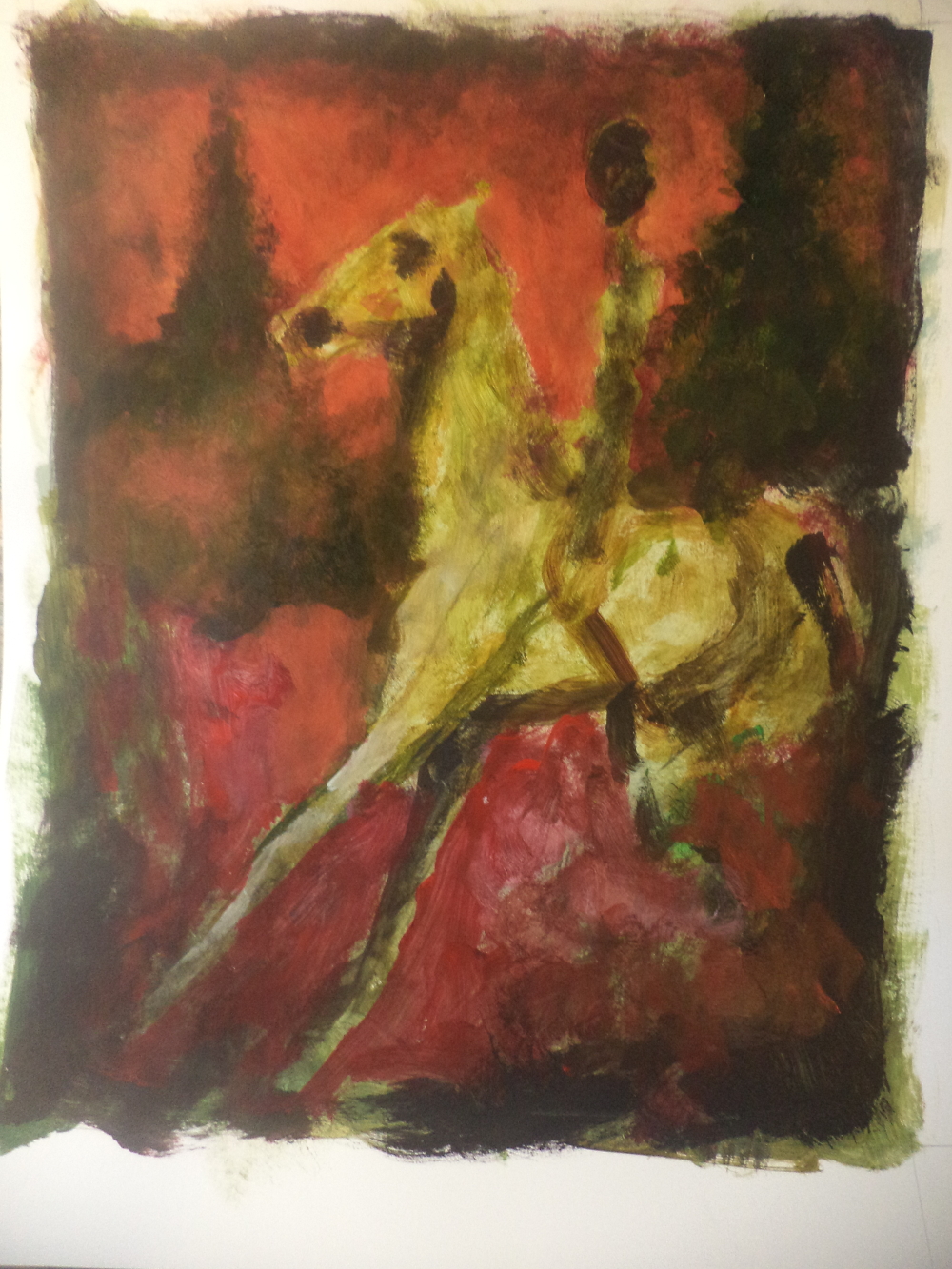
A Pale Rider


Work in progress. The last person to be buried in a churchyard each year is called the Ankon, who becomes death itself. He rides through town in the form of a skeleton and is a portent of death. - Folk Lore of Brittany

Monday, June 8, 2015

The Temptation of St. Anthony


 Work in progress by Julie Kwiatkowski Schuler.
I have been looking at a lot of the surreal, crowded, and incredible paintings of the Temptation of St. Anthony, but the temptations are still sex and money. I decided to go the opposite way and make my interpretation more simple. A wax anatomical model demonstrating the syphilitic plaques of the tongue. Money to come later.

Thursday, May 28, 2015

Vox Piscis


Another day of work in progress on Vox Piscis. The Voice of the Fish.

Wednesday, May 27, 2015

Vox Piscis


Vox Pisces, 8″ x 10″, a work in progress by Julie Kwiatkowski Schuler.
I enjoy the patina of folk tale on this story, about a book. There’s quite probably a book called Vox Piscis. It may be at the threshold of truth, that it was found at a fish market. It does strain credulity that it was found in the stomach of a 93 year old cod fish. An Atlantic cod has a lifespan of 25 years, tops. Actually, you couldn’t fit a book in an immature codfish. So, the fish would have had to have been 8 years old already, to reach full size. That would have had to have been a hundred and one year old cod fish, in which the treatise was found. Satisfying as a story, but not very manageable in the light of cold reason.

Anyway, the story that launched this piece:
On June 23, 1626, a fishmonger in Cambridge, England gutted a cod and found a book inside, wrapped in a sailcloth. It was a discourse on the sacraments written by Protestant priest, John Firth, burned at the stake in 1533. Before he was executed he was imprisoned in an Oxford fish cellar, where he wrote the treatise, stuffed it in a fish, and threw the fish back out into the water, presumably. The volume was called Vox Pisces, The Voice of the Fish.
Sunday, April 12, 2015

Cromniomancy

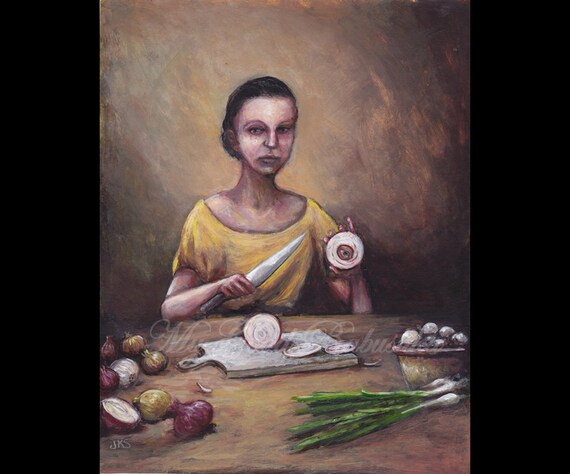
Cromniomancy is divination by onions.

Cromniomancy was usually done by inscribing “yes” or “no” on onions, then planting and asking your question of them to see which one would sprout first. That would be your answer. If it was a question of suitors, one would inscribe the name of possible lovers, one to each onion, then whichever one sprouted first was your true intended.

Original 8" x 10" acrylic on heavy paper painting by Julie Kwiatkowski Schuler

Saturday, April 11, 2015

Cromniomancy


Cromniomancy. Divination by onions. Work in progress today by Julie Kwiatkowski Schuler.
Cromniomancy was usually done by inscribing “yes” or “no” on onions, then planting and asking your question of them to see which one would sprout first. That would be your answer. If it was a question of suitors, one would inscribe the name of possible lovers, one to each onion, then whichever one sprouted first was your true intended.
I think I may be done with this piece after one more day of work.

Friday, April 10, 2015

Thursday, April 9, 2015

Cromniomancy


Cromniomancy. Divination by onions. Work in progress today by Julie Kwiatkowski Schuler.
Cromniomancy was usually done by inscribing “yes” or “no” on onions, then planting and asking your question of them to see which one would sprout first. That would be your answer. If it was a question of suitors, one would inscribe the name of possible lovers, one to each onion, then whichever one sprouted first was your true intended.

Wednesday, April 8, 2015

Cromniomancy


Cromniomancy is divination by onions.
I've decided to make a painting of it.

Tuesday, April 7, 2015

The Boy Who Drowned


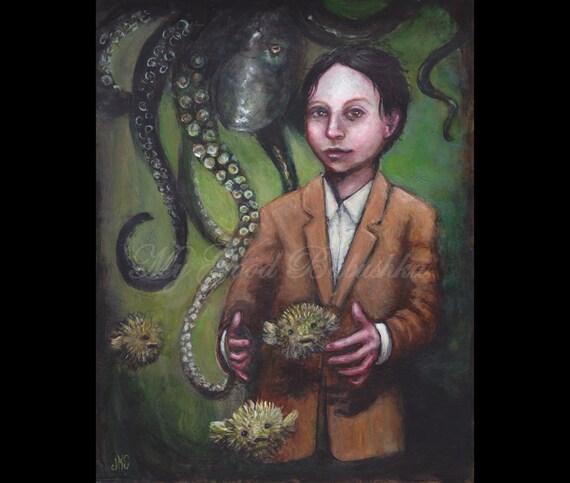
The Drowned Boy. Original 8" x 10" acrylic on heavy paper painting by Julie Kwiatkowski Schuler.
Inspired by the folk belief that one born with a blue vein on the side of one's nose was destined to be drowned. I've given my drowned boy an octopus, and some puffer fish friends.

Painting does not contain the black bars on the sides, nor the "My Good Babushka" watermark, which were included here for formatting and security purposes.

Monday, April 6, 2015

The Boy Who Drowned


Inspired by a superstition that one born with a blue vein on the side of one's nose was destined to be drowned. A drowned boy and his friends.

Saturday, April 4, 2015

The Boy Who Will Drown


Inspired by the superstition that one born with a blue vein on the side of one's nose was destined to be drowned.

Friday, April 3, 2015

The Boy Who Will Drown


I read somewhere that if one was born with a prominent blue vein on the side of one’s nose, it meant that one was destined to be drowned. I can’t remember exactly where I read it. I think it was probably W.C. Hazlitt’s Dictionary of Faiths and Folklore. It’s been my go-to volume for the past year.
Today I’ve started a painting using this theme. This is to be my drowned boy.

Tuesday, December 23, 2014

The Merry Thought


"I have known the shooting of a star spoiling a night’s rest; and have seen a man in love grow pale, and lose his appetite, upon the plucking of a merry-thought." Addison, Omens

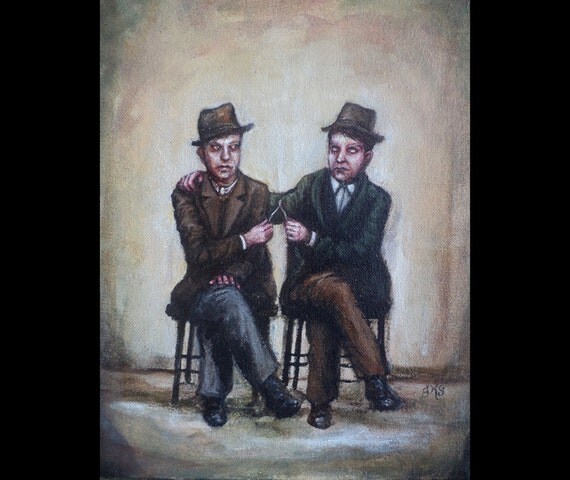
Merrythought n. the fureula or wishbone of a fowl’s breast; so called from the sport of breaking it between two persons of whom each pulls at one of the two ends, to determine which is to be married first, or which is to have a wish gratified that has been mentally formed for the occasion, the winner being the one who gets the longer fragment. - from The Century Dictionary and Cyclopedia 1899

Original painting inspired by the Merry Thought. 8" x 10" acrylic on stretched canvas. By Julie Kwiatkowski Schuler

Sunday, December 21, 2014

The Merry Thought


"I have known the shooting of a star spoiling a night’s rest; and have seen a man in love grow pale, and lose his appetite, upon the plucking of a merry-thought." Addison, Omens

Merrythought n. the fureula or wishbone of a fowl’s breast; so called from the sport of breaking it between two persons of whom each pulls at one of the two ends, to determine which is to be married first, or which is to have a wish gratified that has been mentally formed for the occasion, the winner being the one who gets the longer fragment. - from The Century Dictionary and Cyclopedia 1899

Work in  progress 8" x 10"