Showing posts with label architect. Show all posts

Wednesday, July 17, 2013

Didymus


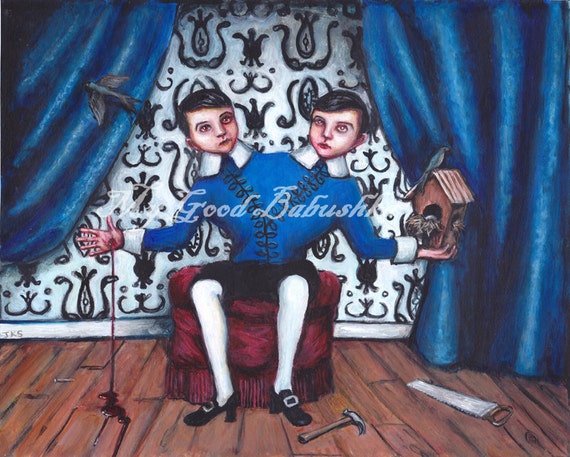
I have finished Didymus. Here is how the completed work looks:

This painting is inspired by my reading of The Golden Legend by Jacobus de Voragine. He wrote a compendium of the saints. This one in particular is for St. Thomas the Apostle. Thomas was called the twin of Jesus, also Didymus, which means twin. I have represented Thomas as conjoined twins. Conjoined twins reinforce the notion of a spiritual connectivity, as feeling and living in the same body must give a unique connectivity that transcends what most people will ever experience. This particular twin configuration was inspired by the Tocci twins, Giacomo and Giovanni. Giacomo and Giovanni Tocci were conjoined twins born in Italy in the late 19th century.

Saint Thomas was an architect. So I've represented that with the building tools and the birdhouse. The holy spirit is usually represented as a dove, so I thought a birdhouse would be a most appropriate construction. The other hand is covered in blood because Thomas was a doubter, and he could only be convinced of the resurrection by putting his hand in the wound of Christ. The closure on the front of the jacket is in the shape of a Y, echoing the Y incision that a doctor would use in an autopsy. It is a wound that signifies inquiry and investigation.

This is an original painting by Julie Kwiatkowski Schuler, acrylic on acid free paper 8" x 10"
The "My Good Babushka" watermark is for security purposes and is not on the painting.

You can find purchasing information Here at My Good Babushka.

Tuesday, July 16, 2013

Didymus


 Sharpening up the details of the right side twin and figuring out how to get the floor on that side sorted out.

If you're new to this painting:
This painting is inspired by my reading of The Golden Legend by Jacobus de Voragine. He wrote a compendium of the saints. This one in particular is for St. Thomas the Apostle. Thomas was called the twin of Jesus, also Didymus, which means twin. I have represented Thomas as conjoined twins. Conjoined twins reinforce the notion of a spiritual connectivity, as feeling and living in the same body must give a unique connectivity that transcends what most people will ever experience. This particular twin configuration was inspired by the Tocci twins, Giacomo and Giovanni. Giacomo and Giovanni Tocci were conjoined twins born in Italy in the late 19th century. Saint Thomas was an architect. So I've represented that with the building tools and the birdhouse. The holy spirit is usually represented as a dove, so I thought a birdhouse would be a most appropriate construction. The other hand is covered in blood because Thomas was a doubter, and he could only be convinced of the resurrection by putting his hand in the wound of Christ. The closure on the front of the jacket is in the shape of a Y, echoing the Y incision that a doctor would use in an autopsy. It is a wound that signifies inquiry and investigation.

Friday, July 12, 2013

Didymus


Worked on the second face, right side curtains, floorboards, straightening up some of that wallpaper pattern today.

This painting is inspired by my reading of The Golden Legend by Jacobus de Voragine. He wrote a compendium of the saints. This one in particular is for St. Thomas the Apostle. Thomas was called the twin of Jesus, also Didymus, which means twin. I have represented Thomas as conjoined twins. Conjoined twins reinforce the notion of a spiritual connectivity, as feeling and living in the same body must give a unique connectivity that transcends what most people will ever experience. This particular twin configuration was inspired by the Tocci twins, Giacomo and Giovanni. Giacomo and Giovanni Tocci were conjoined twins born in Italy in the late 19th century. Saint Thomas was an architect. So I've represented that with the building tools and the birdhouse. The holy spirit is usually represented as a dove, so I thought a birdhouse would be a most appropriate construction. The other hand is covered in blood because Thomas was a doubter, and he could only be convinced of the resurrection by putting his hand in the wound of Christ. The closure on the front of the jacket is in the shape of a Y, echoing the Y incision that a doctor would use in an autopsy. It is a wound that signifies inquiry and investigation.

Thursday, July 11, 2013

Didymus


 Some bits of the wall paper need to be reworked, but I felt like moving on and doing the face. I also need to fix up that hand.

This painting is inspired by my reading of The Golden Legend by Jacobus de Voragine. He wrote a compendium of the saints. This one in particular is for St. Thomas the Apostle. Thomas was called the twin of Jesus, also Didymus, which means twin. I have represented Thomas as conjoined twins. Conjoined twins reinforce the notion of a spiritual connectivity, as feeling and living in the same body must give a unique connectivity that transcends what most people will ever experience. This particular twin configuration was inspired by the Tocci twins, Giacomo and Giovanni. Giacomo and Giovanni Tocci were conjoined twins born in Italy in the late 19th century. Saint Thomas was an architect. So I've represented that with the building tools and the birdhouse. The holy spirit is usually represented as a dove, so I thought a birdhouse would be a most appropriate construction. The other hand is covered in blood because Thomas was a doubter, and he could only be convinced of the resurrection by putting his hand in the wound of Christ. The closure on the front of the jacket is in the shape of a Y, echoing the Y incision that a doctor would use in an autopsy. It is a wound that signifies inquiry and investigation.

Monday, July 8, 2013

Didymus


Damask wallpaper is always a gruesome undertaking. I think in the end it will be worth it.

This painting is inspired by my reading of The Golden Legend by Jacobus de Voragine. He wrote a compendium of the saints. This one in particular is for St. Thomas the Apostle. Thomas was called the twin of Jesus, also Didymus, which means twin. I have represented Thomas as conjoined twins. Conjoined twins reinforce the notion of a spiritual connectivity, as feeling and living in the same body must give a unique connectivity that transcends what most people will ever experience. This particular twin configuration was inspired by the Tocci twins, Giacomo and Giovanni. Giacomo and Giovanni Tocci were conjoined twins born in Italy in the late 19th century. Saint Thomas was an architect. So I've represented that with the building tools and the birdhouse. The holy spirit is usually represented as a dove, so I thought a birdhouse would be a most appropriate construction. The other hand is covered in blood because Thomas was a doubter, and he could only be convinced of the resurrection by putting his hand in the wound of Christ. The closure on the front of the jacket is in the shape of a Y, echoing the Y incision that a doctor would use in an autopsy. It is a wound that signifies inquiry and investigation.

Friday, July 5, 2013

St Thomas the Apostle. Didymus. The Twin. The Doubter. The Architect.


This sketch is inspired by my reading of The Golden Legend by Jacobus de Voragine. He wrote a compendium of the saints. This one in particular is for St. Thomas the Apostle. Thomas was called the twin of Jesus, also Didymus, which means twin. I have represented Thomas as conjoined twins. Conjoined twins reinforce the notion of a spiritual connectivity, as feeling and living in the same body must give a unique connectivity that transcends what most people will ever experience. This particular twin configuration was inspired by the Tocci twins, Giacomo and Giovanni. Giacomo and Giovanni Tocci were conjoined twins born in Italy in the late 19th century. Saint Thomas was an architect. So I've represented that with the building tools and the birdhouse. The holy spirit is usually represented as a dove, so I thought a birdhouse would be a most appropriate construction. The other hand is covered in blood because Thomas was a doubter, and he could only be convinced of the resurrection by putting his hand in the wound of Christ. I think the closure on the front of the jacket is going to be in the shape of a Y, echoing the Y incision that a doctor would use in an autopsy. It is a wound that signifies inquiry and investigation.

Monday, June 24, 2013

Thomas Thomas


This sketch is inspired by my reading of The Golden Legend by Jacobus de Voragine. He wrote a compendium of the saints. This one in particular is for St. Thomas the Apostle. Thomas was called the twin of Jesus, also Didymus, which means twin. I have represented Thomas as conjoined twins. Conjoined twins reinforce the notion of a spiritual connectivity, as feeling and living in the same body must give a unique connectivity that transcends what most people will ever experience. This particular twin configuration was inspired by the Tocci twins, Giacomo and Giovanni. Giacomo and Giovanni Tocci were dicephalic conjoined twins born in Italy in the late 19th century. Saint Thomas was an architect. So I've represented that with the building tools and the birdhouse. The holy spirit is usually represented as a dove, so I thought a birdhouse would be a most appropriate construction. The other hand is covered in blood because Thomas was a doubter, and he could only be convinced of the resurrection by putting his hand in the wound of Christ.


Friday, April 19, 2013

Saint Thomas Sketches


 Saint Thomas the Apostle was an architect. He took money from a king to build him a palace then gave all that money to the poor and told the kind that his palace was built for him in heaven. I think that's called fraud. Struggling with how to represent Saint Thomas because after Caravaggio's Thomas everything else is an also-ran. There is nothing as psychologically charged and aesthetically delicious as sticking your finger into the wound of Christ. I guess that's why he's best known as the Doubter.

Saint Thomas the Apostle was also called Didymus, the twin, Jesus's twin. He was mystically present at the ascension of Mary into heaven and he caught her girdle which she threw down to him as she ascended.

I started out by making a grossly exaggerated version of the investigation of the wound. I felt if one person was crawling through the other, it would give the impression of conjoined twins. Several times I thought I was onto something... but I wasn't

I beat a hasty retreat to the idea of architecture. And faith as an impropable, impossible edifice.
I made a new Thomas lifting these boulders and constructing inspiring, faith-based towers.


That’s okay, but it’s not as densely packed as I would like. I’m missing references to the wound, the doubt, Mary’s ascension, the idea of twins- I’d really like to pack in the symbolism, if possible. So I guess I will keep noodling around with this idea.