


Here is the finished painting of St. Anastasia:
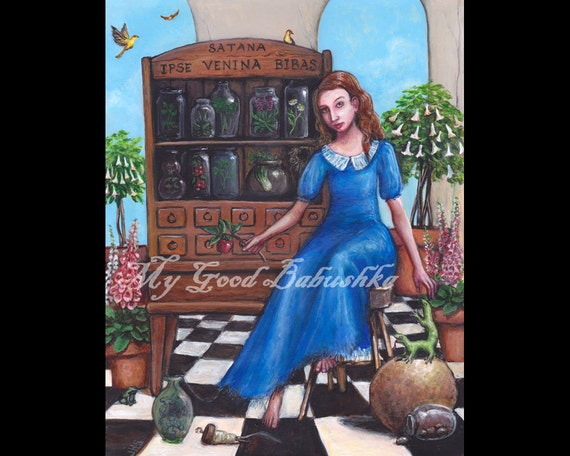
Saint Anastasia was an early Christian martyr known as a deliverer from
poisons, exorcist, and patroness of weavers. This is a painting devoted
to her and full of symbolism. The birds are golden weavers because she
is the patroness of weavers. In the background, flanking the apothecary
cabinet are angel trumpets and foxglove, both very poisonous plants,
because she is a deliverer from poisons.
The top of the apothecary cabinet is inscribed with the Latin "Satana Ipse Venina Bibas" which translates into "Satan, take the poison yourself." because she is a noted exorcist. The apothecary cabinet is filled with nine herbs- mugwort, plantain, betony, chamomile, nettle, crab apple, chervil, and fennel- because those are the nine plants named in the ancient Anglo-Saxon nine herb charm that was supposed to be a powerful antidote against poisons, mainly snake venom. In the corner of the apothecary cabinet is the golden weaver bird's nest.
There is a frog at the base of the left potted foxglove, very often thought in medieval time to be venomous, and inhabiting areas of unhealthful miasmas. The saint's dress in raveling and the thread is tangled up in a witch bottle. A bottle with tangled string is called a witch bottle, it is a labyrinth in brief, and if you put a witch bottle outside your home, it was thought to confuse witches and other evil entities and prevent them from coming into your home. Next to the witch bottle is a drop spindle, another sign of the weaver. On the right side corner of the painting is a jar of bezoars, supposed to have great medicinal value in the middle ages. An amphibaena is brought to heel at her hand, the amphisbaena anciently believed to be a reptile with a head at either end of it's body which can poison by it's eyes.
Amongst all these symbols of ancient to medieval wonder and miracle, Saint Anastasia sits offering the apple, the symbol of knowledge, freedom from superstition and folklore, but also a symbol of the fall from grace and of our mortality.
This is an original painting, approximately 8" x 10". Painted and signed by Julie Kwiatkowski Schuler. The black borders and "My Good Babushka" watermark are not on the actual painting.
You can find purchasing information here at My Good Babushka


 Posts


