Showing posts with label military history. Show all posts
Saturday, September 5, 2015
The Priscilla Test
The Priscilla Test, Part of Operation Plumbbob. 9" x 12" acrylic on acid free paper. By Julie Kwiatkowski Schuler.
Operation Plumbbob was a series of nuclear tests conducted between May 28 and October 7, 1957, at a Nevada Test Site. It was the biggest, longest, and most controversial test series in the continental United States.
On shot Priscilla (37 kt), 719 pigs were used in various experiments on Frenchman Flat. Some pigs were placed in elevated cages and provided with suits made of different materials, to test which materials provided best protection from the thermal radiation. The pigs survived, but with third-degree burns to 80% of their bodies. Other pigs were placed in pens behind large sheets of glass at measured distances from the hypocenter to test the effects of flying debris on living targets. Studies were conducted of radioactive contamination and fallout from a simulated accidental detonation of a weapon; and projects concerning earth motion, blast loading and neutron output were carried out.
Plumbbob released 58,300 kilocuries (2.16 EBq) of radioiodine (I-131) into the atmosphere. This produced total civilian radiation exposures amounting to 120 million person-rads of thyroid tissue exposure (about 32% of all exposure due to continental nuclear tests).
Statistically speaking, this level of exposure would be expected to eventually cause between 11,000 and 212,000 excess cases of thyroid cancer, leading to between 1,000 and 20,000 deaths.
In addition to civilian exposure, troop exercises conducted near the ground near shot Smoky exposed over three thousand servicemen to relatively high levels of radiation. A survey of these servicemen in 1980 found significantly elevated rates of leukemia.
Labels:
art,
cold war,
history,
military history,
Nevada,
nuclear bomb,
operation plumbbob,
painting,
priscilla test
Friday, September 4, 2015
Thursday, September 3, 2015
Wednesday, September 2, 2015
The Priscilla Test
Painting in progress today.
Operation Plumbbob was a series of nuclear tests conducted between May 28 and October 7, 1957, at the Nevada Test Site. It was the biggest, longest, and most controversial test series in the continental United States.
On shot Priscilla (37 kt), 719 pigs were used in various experiments on Frenchman Flat. Some pigs were placed in elevated cages and provided with suits made of different materials, to test which materials provided best protection from the thermal radiation. The pigs survived, but with third-degree burns to 80% of their bodies. Other pigs were placed in pens behind large sheets of glass at measured distances from the hypocenter to test the effects of flying debris on living targets. Studies were conducted of radioactive contamination and fallout from a simulated accidental detonation of a weapon; and projects concerning earth motion, blast loading and neutron output were carried out.
Plumbbob released 58,300 kilocuries (2.16 EBq) of radioiodine (I-131) into the atmosphere. This produced total civilian radiation exposures amounting to 120 million person-rads of thyroid tissue exposure (about 32% of all exposure due to continental nuclear tests).
Statistically speaking, this level of exposure would be expected to eventually cause between 11,000 and 212,000 excess cases of thyroid cancer, leading to between 1,000 and 20,000 deaths.
In addition to civilian exposure, troop exercises conducted near the ground near shot Smoky exposed over three thousand servicemen to relatively high levels of radiation. A survey of these servicemen in 1980 found significantly elevated rates of leukemia.
Labels:
art,
history,
military history,
operation plumbbob,
painting,
priscilla test
Tuesday, September 1, 2015
Monday, June 22, 2015
Harold Agnew and the Plutonium Core
Original 8" x 10' acrylic painting on thick, acid-free paper.
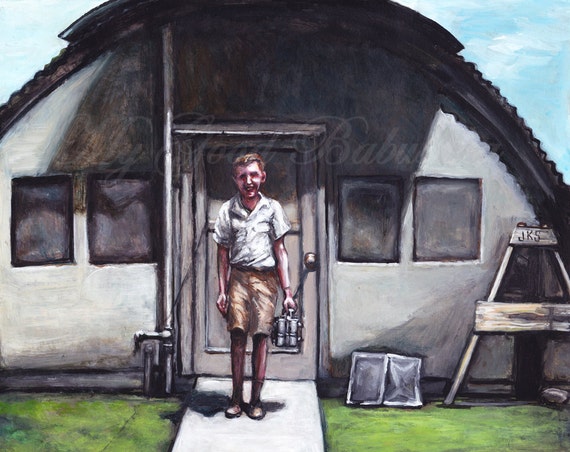
Harold Agnew was an American physicist who flew as a scientific observer on the Hiroshima bombing mission. This painting was modeled after a photo of Agnew from 1945 on the Mariana Islands. He is standing in front of a quonset hut and holding the plutonium core for the Fat Man bomb that would be dropped on Nagasaki.
Harold Agnew and the Plutonium Core by Julie Kwiatkowski Schuler. The painting does not include the "My Good Babushka" watermark which was included here for security purposes.
Harold Agnew was an American physicist who flew as a scientific observer on the Hiroshima bombing mission. This painting was modeled after a photo of Agnew from 1945 on the Mariana Islands. He is standing in front of a quonset hut and holding the plutonium core for the Fat Man bomb that would be dropped on Nagasaki.
Harold Agnew and the Plutonium Core by Julie Kwiatkowski Schuler. The painting does not include the "My Good Babushka" watermark which was included here for security purposes.
Labels:
art,
Fat Man,
Harold Agnew,
hiroshima,
military history,
Nagasaki,
painting,
plutonium core,
World War 2
Subscribe to:
Posts (Atom)