A Pale Rider. By Julie Kwiatkowski Schuler. The last person to be buried in a churchyard each year is called the Ankon, who becomes death itself. He rides through town in the form of a skeleton and is a portent of death. - Folk Lore of Brittany
Showing posts with label horse. Show all posts
Thursday, October 13, 2016
A Pale Rider
A Pale Rider. By Julie Kwiatkowski Schuler. The last person to be buried in a churchyard each year is called the Ankon, who becomes death itself. He rides through town in the form of a skeleton and is a portent of death. - Folk Lore of Brittany
Labels:
ankon,
art,
dark art,
death,
fairy tale,
folk tale,
horse,
macabre art,
painting,
pale rider,
skull
Tuesday, April 26, 2016
A Winter Tale
Labels:
art,
black dress,
black horse,
fairy tale,
folk tale,
forest,
horse,
painting,
snow,
winter
Monday, April 25, 2016
Sunday, April 24, 2016
A Winter Tale
Labels:
art,
fairy tale,
folk tale,
forest,
horse,
painting,
snow,
winter,
work in progress
Friday, April 22, 2016
A Winter Tale
Labels:
art,
fairy tale,
folk tale,
forest,
horse,
painting,
snow,
winter,
work in progress
Wednesday, March 5, 2014
St. Stephen's Day
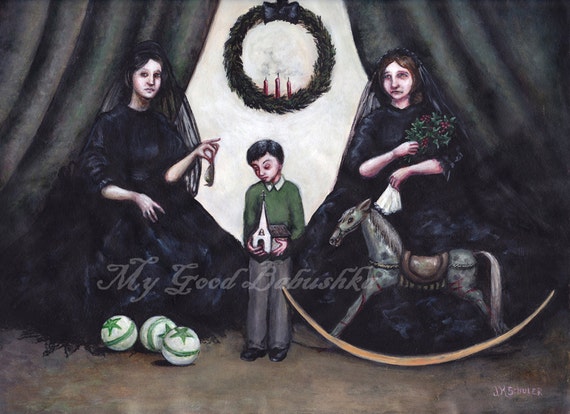
This is an acrylic painting on acid-free paper 9" x 11". It is a symbolic painting of St. Stephen and the lore around St. Stephen's Day.
St. Stephen was known as the patron saint of widows, so he is flanked by two women in Victorian mourning dresses. At the feet of the woman on the left sit three balls. St. Stephen is often depicted with three stones to indicate that he was put to death by stoning. Here the three balls stand in for the three stones. The widow on the left is also holding a dead wren. According to lore, St. Stephen was about to escape his captivity when a wren woke up his captors. Since that time, a wren was caught and killed each St. Stephen's Day because it must now take a part of his martyrdom.
St. Stephen is often depicted as a young man holding a miniature church. Here he is depicted as a child, also holding a church in miniature. To the right of St.Stephen is a rocking horse with bleeding legs. St. Stephen's Day, in medieval through Victorian times, was a day to bleed horses in order to preserve their health in the coming year.
Ancient Welsh custom, discontinued in the 19th century, included the "holming" (beating or slashing with holly branches) of late risers and female servants. My widow on the right is holding a branch of holly to remind us of this forgotten tradition.
St. Stephen's Day is the day after Christmas, that is why the candles are just put out in the wreath at the center of the composition.
St. Stephen's Day. Original, one of a kind art by Julie K. Schuler. The "My Good Babushka" watermark in the first picture is not on the actual painting, but is included here for security purposes.
Labels:
art,
Christian martyr,
church,
folklore,
holly,
holming,
horse,
painting,
rocking horse,
St. Stephen,
St. Stephen's Day,
Victorian mourning dresses,
widows,
wren
Monday, February 10, 2014
The Colt-Pixy
The Colt-Pixy is a mischievous spirit that draws travelers into the woods and bogs, leaving them stranded, to perish. Kind of the like the siren of the swamp. Here I am imagining it at a primitive contraption built of a horsehide, some rope, sticks and an old gramophone.
The finished Colt-Pixy painting is at My Good Babushka.
Labels:
art,
Colt-Pixy,
dark forest,
English folklore,
gramophone,
horse,
horsehide,
painting,
steampunk
Tuesday, September 17, 2013
Marocco
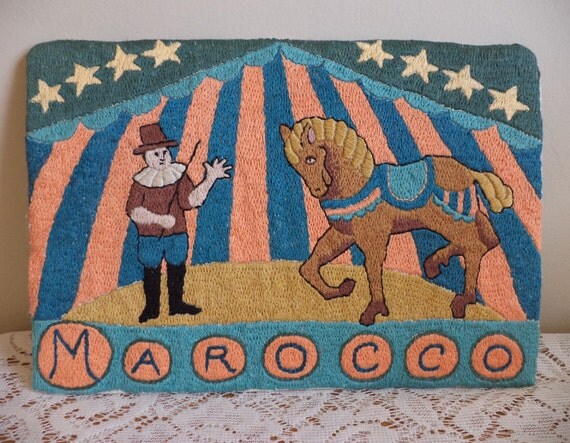
Marocco (c. 1586 – c. 1606) was also
known as Bankes's Horse (after his trainer William Bankes). He was a
performing horse and his act was well known around London. He traveled
abroad to perform in France, where Marocco and Bankes were arrested and
accused of witchcraft. Marocco saved himself and his trainer by learning
to bow to the cross when it was presented.
This is my tribute to the remarkable Marocco and Mr. Bankes. A one of a kind art textile. Hand embroidered 8" x 12" stretched and mounted over card board, ready for framing.
You can read more about it Here at My Good Babushka.
This is my tribute to the remarkable Marocco and Mr. Bankes. A one of a kind art textile. Hand embroidered 8" x 12" stretched and mounted over card board, ready for framing.
You can read more about it Here at My Good Babushka.
Labels:
art,
circus pony,
England,
hand embroidery,
history,
horse,
London,
marocco,
needlework,
william bankes
Friday, September 6, 2013
Marocco Embroidery
Here is my embroidered tribute to William Bankes and Marocco.
More than half done now.
Labels:
embroidery,
England,
folklore,
France,
history,
horse,
marocco,
needlework,
trick,
william bankes,
witchcraft
Wednesday, August 28, 2013
Thursday, August 22, 2013
Marocco
Marocco was the trained performing horse of Mr. William Bankes who lived in the late 16th - 17th century in England. He was a very famous and beloved performer. Whilst travelling in France, however, the two were accused of witchcraft! Bankes was clever and taught Marocco to bow down when the cross was produced, and that is how Bankes and Marocco escaped and saved their necks!
Here is my embroidered tribute to William Bankes and Marocco.
Labels:
embroidery,
England,
folklore,
France,
history,
horse,
marocco,
needlework,
trick,
william bankes,
witchcraft
Subscribe to:
Posts (Atom)