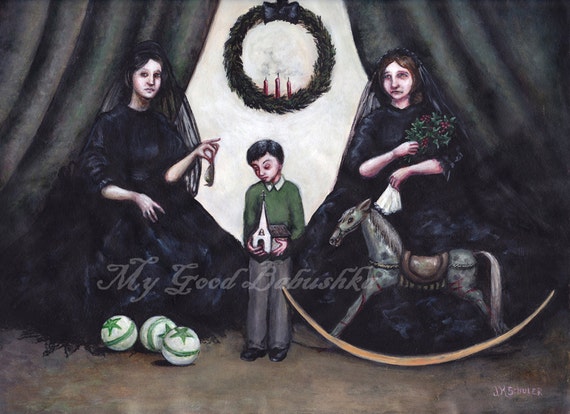
This is an acrylic painting on acid-free paper 9" x 11". It is a
symbolic painting of St. Stephen and the lore around St. Stephen's Day.
St. Stephen was known as the patron saint of widows, so he is flanked
by two women in Victorian mourning dresses. At the feet of the woman on
the left sit three balls. St. Stephen is often depicted with three
stones to indicate that he was put to death by stoning. Here the three
balls stand in for the three stones. The widow on the left is also
holding a dead wren. According to lore, St. Stephen was about to escape
his captivity when a wren woke up his captors. Since that time, a wren
was caught and killed each St. Stephen's Day because it must now take a
part of his martyrdom.
St. Stephen is often depicted as a young man
holding a miniature church. Here he is depicted as a child, also
holding a church in miniature. To the right of St.Stephen is a rocking
horse with bleeding legs. St. Stephen's Day, in medieval through
Victorian times, was a day to bleed horses in order to preserve their
health in the coming year.
Ancient Welsh custom, discontinued in
the 19th century, included the "holming" (beating or slashing with holly
branches) of late risers and female servants. My widow on the right is
holding a branch of holly to remind us of this forgotten tradition.
St. Stephen's Day is the day after Christmas, that is why the candles
are just put out in the wreath at the center of the composition.
St. Stephen's Day. Original, one of a kind art by Julie K. Schuler. The "
My Good Babushka"
watermark in the first picture is not on the actual painting, but is
included here for security purposes.










 Posts
Posts