Showing posts with label Jacobus de Voragine. Show all posts
Thursday, July 30, 2015
Sebastian Gives Zoe the Voice of a Nightingale
There is a story in The Golden Legend about Saint Sebastian miraculously giving a mute woman, Zoe, her voice back. I've thought about it, and decided to make Sebastian recording the song of nightingales on a wax cylinder recording to give to Zoe.
Wednesday, April 29, 2015
Marcellus
Marcellus. A work in progress by Julie Kwiatkowski Schuler.
Nude with a skull of a long-horned steer. Inspired by the legend of Pope Marcellus I. Emperor Maximian, who ruled from 286 to 305, converted his church to a barn and he was condemned to spend the remainder of his days in menial labor, taking care of the animals.
Sunday, April 26, 2015
Marcellus
A simple little painting inspired by the legend of Pope Marcellus I. Emperor Maximian, who ruled from 286 to 305, converted his church to a barn and he was condemned to spend the remainder of his days in menial labor, taking care of the animals.
Study of a nude with the skull of a long-horned steer.
Friday, February 20, 2015
Felix
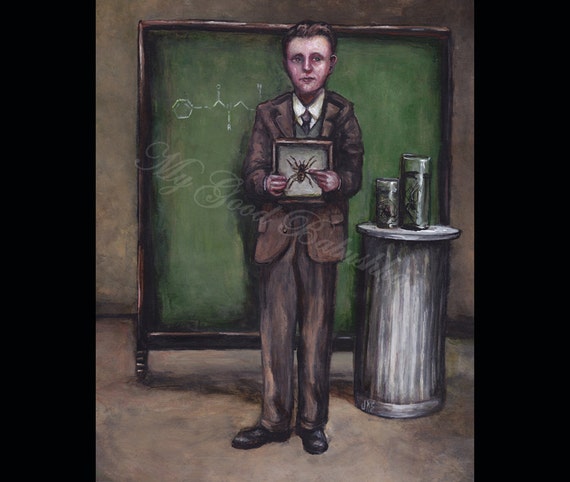
Painting inspired by the story of Saint Felix in the Golden Legend of Jacobus de Voragine. Saint Felix was a third century saint who evaded capture by Roman soldiers by hiding in a vacant house whilst spiders miraculously wove webs across the doorway, making it look like no one had passed through.
Felix here is an intrepid Victorian anthropologist, showing us spider specimens. Behind him is the chemical composition for spider venom written on the chalkboard. An entomologist's reverie.
8" x 10" acrylic on acid free paper by Julie Kwiatkowski Schuler.
Felix does not contain the black bars nor the "My Good Babushka" watermark included here for security and formatting purposes.
Thursday, February 19, 2015
Felix
Felix. Work in progress today. St. Felix was a third century saint. There is a legend that he hid the persecuted bishop Maximus in a vacant building. Spiders came to his aid and spun webs across the doorway, fooling the centurions into believing no one had passed through that way. The soldiers were diverted and the two prisoners escaped and lived.
My Felix will be showing off his spider specimens. Work in progress by Julie Kwiatkowski Schuler.
Thursday, October 30, 2014
The Bird Feeder
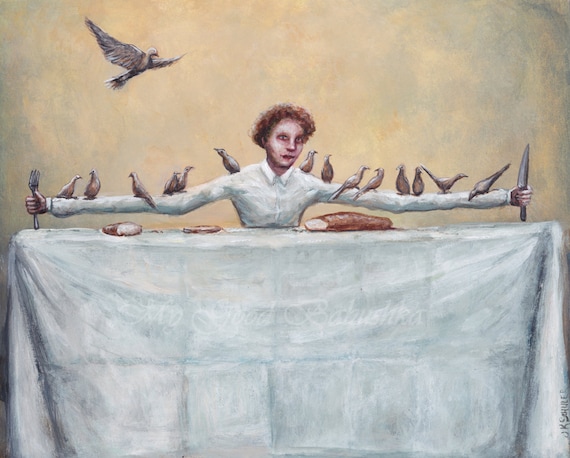
The Bird Feeder. At My Good Babushka. The Bird Feeder. Original acrylic painting 8" x10" on acid free paper by Julie Kwiatkowski Schuler.
Inspired by the Golden Legend of Jacobus de Voragine. The story of St. Remy. Birds accompanied him whenever he sat down to eat, to share in his food. I imagined when he sat down to dine his arms grew long enough for his dinner companions to have a nice perch. Surreal fairy tale charm.
Labels:
art,
bird feeder,
birds,
bread,
fairy tale,
folk tale,
Jacobus de Voragine,
painting,
st remy,
The Golden Legend
Wednesday, October 29, 2014
The Bird Feeder.
The Bird Feeder. Work in progress today.
Inspired by the Golden Legend of Jacobus de Voragine. The story of St. Remy. Birds accompanied him whenever he sat down to eat, to share in his food. I imagined when he sat down to dine his arms grew long enough for his dinner companions to have a nice perch. Surreal fairy tale charm.
Labels:
art,
bird feeder,
birds,
bread,
fairy tale,
folk tale,
golden legend,
Jacobus de Voragine,
painting,
St. Remy
Tuesday, October 28, 2014
The Birdfeeder
There is an apocryphal story in The Golden Legend of St. Remy, and how whenever he at the birds came down to share his meal because he was so gentle and blessed. I thought to depict this meal, being shared with the birds, too many birds, and Remy's arms growing long enough for all the birds to perch on them as they were eating his bread.
Labels:
art,
birdfeeder,
birds,
bread,
Jacobus de Voragine,
painting,
St. Remy,
The Golden Legend
Thursday, October 23, 2014
Fairy Tale for Paul
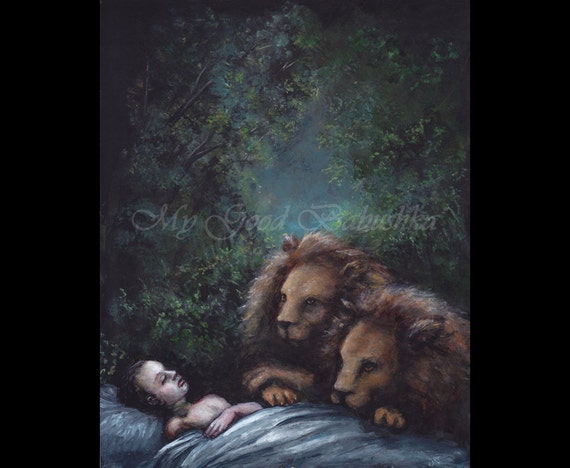
Inspired by the apocryphal story of St. Paul the Hermit in The Golden Legend of Jacobus de Voragine. After his death, Paul was attended to and buried by two lions. The scene has a fairy tale, folk tale charm.
Fairy Tale for Paul at My Good Babushka
Labels:
apocrypha,
art,
fable,
fairy tale,
folk tale,
hermit,
Jacobus de Voragine,
lions,
painting,
St. Paul,
The Golden Legend
Friday, August 15, 2014
St. Thomas of Canterbury
I am always reading Jacobus de Voragine’s The Golden Legend, a compendium of Christian saints, their histories and apocrypha. This is a sketch that I’ve come up with for St. Thomas of Canterbury, also known as Thomas Becket. He suffered a pretty bad wounding to the head from King Henry’s men and is often depicted with a sword through his head. I’ve drawn from my love for anatomical illustration to show him with his brain exposed and holding a slice of his preserved brain. An abhorrence to nightingales is also ascribed to Becket, who is said to have been so disturbed in his devotions by the song of a nightingale that he commanded that none should sing in the town ever again. Here are some nailed to the wall of this study. As Thomas was chastising a priest for his excessive devotions and masses to the Virgin Mary, the Virgin appeared to the priest and told the priest that Thomas would find his hairshirt mended with red thread. Thomas had put the shirt under his bed to mend it later. Thomas found his hairshirt was indeed mended with red thread and he gave the priest dispensation to continue to honor the Virgin. Here you can see her through the window with her red thread.
I really enjoy cobbling together these scenes of the true and not so true. Hopping across the threshold of accuracy and apocrypha. When I finish one of these, more than my other works, I know that no one else could have made this particular composition with these particular images. I like to convey the impression that it was impossible to get to this image, and yet it exists, because I made it up.
Wednesday, August 6, 2014
St. John the Evangelist
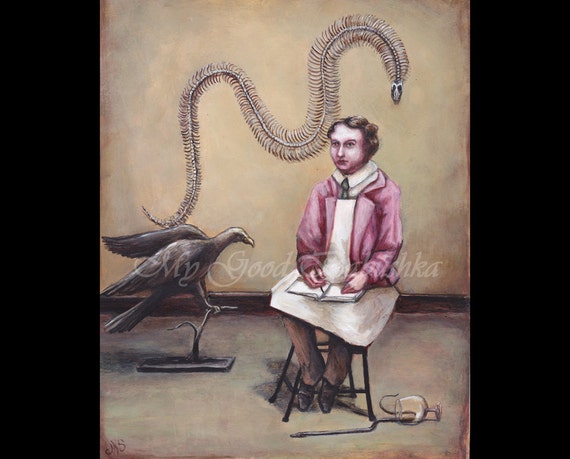
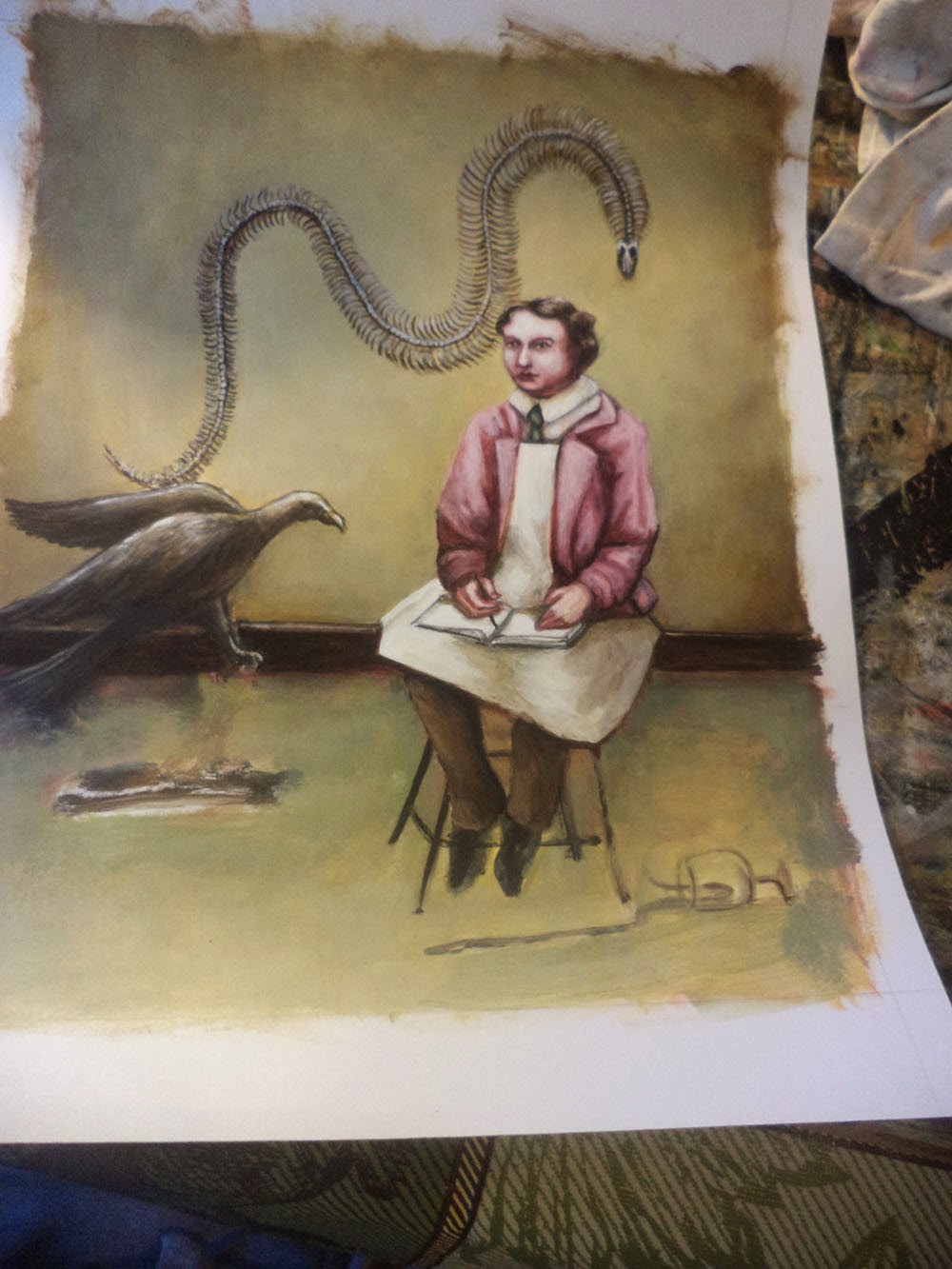
St. John the Evangelist at My Good Babushka. A creative interpretation of St. John the Evangelist. St John is often depicted writing the book of revelations, and with an eagle. He is said to have dumped out a cup of poison which transformed into a snake and slithered away into the wide, wicked world. St. John is sometimes depicted wearing pink and is sometimes confused with Mary Magdalene. I’ve fused the story of St. John the Evangelist and the recent pieces I’ve been doing that have a Victorian/ early natural history museum toner. My St. John is a young scientist taking notes next to his taxidermy eagle. A snake skeleton is mounted on the wall behind him, and at his feet a serpent slithers out of a brandy snifter.
Original acrylic on paper painting, approximately 8" x 10", by Julie Kwiatkowski Schuler. The painting does contain the "My Good Babushka" watermark, or the black side bars, which were included here for security and formatting purposes.
Monday, August 4, 2014
St. John the Evangelist
St. John the Evangelist. St John is often depicted writing, the book of revelations, presumably, and with an
eagle. He is said to have dumped out a cup of poison which transformed
into a snake and slithered away into the wide, wicked world. St. John is
sometimes depicted wearing pink and is sometimes confused with Mary
Magdalene. I’ve sort of got a mash-up going inspired by the story of St.
John the Evangelist and the recent pieces I’ve been doing that have a
Victorian/ early natural history museum sort of flavor. My St. John is a
young scientist taking notes next to his taxidermy eagle. A snake
skeleton is mounted on the wall behind him, and at his feet a serpent
slithers out of a brandy snifter.
Wednesday, July 17, 2013
Didymus
I have finished Didymus. Here is how the completed work looks:
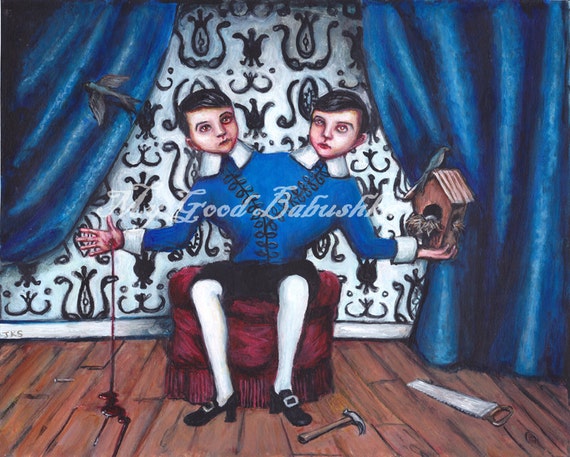
This painting is inspired by my reading of The Golden Legend by Jacobus de Voragine. He wrote a compendium of the saints. This one in particular is for St. Thomas the Apostle. Thomas was called the twin of Jesus, also Didymus, which means twin. I have represented Thomas as conjoined twins. Conjoined twins reinforce the notion of a spiritual connectivity, as feeling and living in the same body must give a unique connectivity that transcends what most people will ever experience. This particular twin configuration was inspired by the Tocci twins, Giacomo and Giovanni. Giacomo and Giovanni Tocci were conjoined twins born in Italy in the late 19th century.
Saint Thomas was an architect. So I've represented that with the building tools and the birdhouse. The holy spirit is usually represented as a dove, so I thought a birdhouse would be a most appropriate construction. The other hand is covered in blood because Thomas was a doubter, and he could only be convinced of the resurrection by putting his hand in the wound of Christ. The closure on the front of the jacket is in the shape of a Y, echoing the Y incision that a doctor would use in an autopsy. It is a wound that signifies inquiry and investigation.
This is an original painting by Julie Kwiatkowski Schuler, acrylic on acid free paper 8" x 10"
The "My Good Babushka" watermark is for security purposes and is not on the painting.
You can find purchasing information Here at My Good Babushka.
Tuesday, July 16, 2013
Didymus
Sharpening up the details of the right side twin and figuring out how to get the floor on that side sorted out.
If you're new to this painting:
This painting is inspired by my reading of The Golden Legend by Jacobus de Voragine. He wrote a compendium of the saints. This one in particular is for St. Thomas the Apostle. Thomas was called the twin of Jesus, also Didymus, which means twin. I have represented Thomas as conjoined twins. Conjoined twins reinforce the notion of a spiritual connectivity, as feeling and living in the same body must give a unique connectivity that transcends what most people will ever experience. This particular twin configuration was inspired by the Tocci twins, Giacomo and Giovanni. Giacomo and Giovanni Tocci were conjoined twins born in Italy in the late 19th century. Saint Thomas was an architect. So I've represented that with the building tools and the birdhouse. The holy spirit is usually represented as a dove, so I thought a birdhouse would be a most appropriate construction. The other hand is covered in blood because Thomas was a doubter, and he could only be convinced of the resurrection by putting his hand in the wound of Christ. The closure on the front of the jacket is in the shape of a Y, echoing the Y incision that a doctor would use in an autopsy. It is a wound that signifies inquiry and investigation.
Subscribe to:
Posts (Atom)