Showing posts with label saint. Show all posts

Tuesday, October 1, 2013

St. Anastasia, Protectress from Poisons, Patroness of Weavers


Here is the finished painting of St. Anastasia:
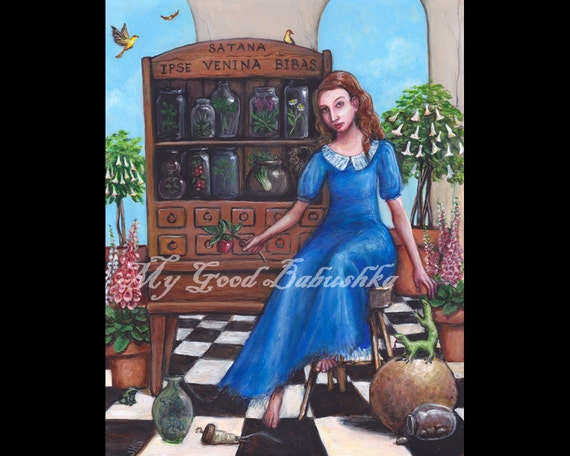
 Saint Anastasia was an early Christian martyr known as a deliverer from poisons, exorcist, and patroness of weavers. This is a painting devoted to her and full of symbolism. The birds are golden weavers because she is the patroness of weavers. In the background, flanking the apothecary cabinet are angel trumpets and foxglove, both very poisonous plants, because she is a deliverer from poisons.

The top of the apothecary cabinet is inscribed with the Latin "Satana Ipse Venina Bibas" which translates into "Satan, take the poison yourself." because she is a noted exorcist. The apothecary cabinet is filled with nine herbs- mugwort, plantain, betony, chamomile, nettle, crab apple, chervil, and fennel- because those are the nine plants named in the ancient Anglo-Saxon nine herb charm that was supposed to be a powerful antidote against poisons, mainly snake venom. In the corner of the apothecary cabinet is the golden weaver bird's nest.

There is a frog at the base of the left potted foxglove, very often thought in medieval time to be venomous, and inhabiting areas of unhealthful miasmas. The saint's dress in raveling and the thread is tangled up in a witch bottle. A bottle with tangled string is called a witch bottle, it is a labyrinth in brief, and if you put a witch bottle outside your home, it was thought to confuse witches and other evil entities and prevent them from coming into your home. Next to the witch bottle is a drop spindle, another sign of the weaver. On the right side corner of the painting is a jar of bezoars, supposed to have great medicinal value in the middle ages. An amphibaena is brought to heel at her hand, the amphisbaena anciently believed to be a reptile with a head at either end of it's body which can poison by it's eyes.

Amongst all these symbols of ancient to medieval wonder and miracle, Saint Anastasia sits offering the apple, the symbol of knowledge, freedom from superstition and folklore, but also a symbol of the fall from grace and of our mortality.

This is an original painting, approximately 8" x 10". Painted and signed by Julie Kwiatkowski Schuler. The black borders and "My Good Babushka" watermark are not on the actual painting. 

You can find purchasing information here at My Good Babushka

Wednesday, July 17, 2013

Didymus


I have finished Didymus. Here is how the completed work looks:

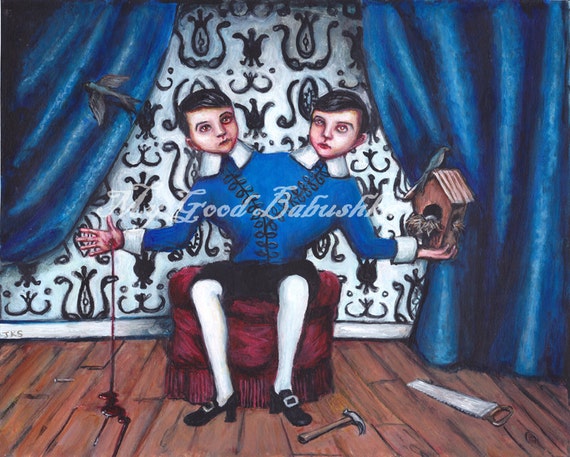
This painting is inspired by my reading of The Golden Legend by Jacobus de Voragine. He wrote a compendium of the saints. This one in particular is for St. Thomas the Apostle. Thomas was called the twin of Jesus, also Didymus, which means twin. I have represented Thomas as conjoined twins. Conjoined twins reinforce the notion of a spiritual connectivity, as feeling and living in the same body must give a unique connectivity that transcends what most people will ever experience. This particular twin configuration was inspired by the Tocci twins, Giacomo and Giovanni. Giacomo and Giovanni Tocci were conjoined twins born in Italy in the late 19th century.

Saint Thomas was an architect. So I've represented that with the building tools and the birdhouse. The holy spirit is usually represented as a dove, so I thought a birdhouse would be a most appropriate construction. The other hand is covered in blood because Thomas was a doubter, and he could only be convinced of the resurrection by putting his hand in the wound of Christ. The closure on the front of the jacket is in the shape of a Y, echoing the Y incision that a doctor would use in an autopsy. It is a wound that signifies inquiry and investigation.

This is an original painting by Julie Kwiatkowski Schuler, acrylic on acid free paper 8" x 10"
The "My Good Babushka" watermark is for security purposes and is not on the painting.

You can find purchasing information Here at My Good Babushka.

Tuesday, July 16, 2013

Didymus


 Sharpening up the details of the right side twin and figuring out how to get the floor on that side sorted out.

If you're new to this painting:
This painting is inspired by my reading of The Golden Legend by Jacobus de Voragine. He wrote a compendium of the saints. This one in particular is for St. Thomas the Apostle. Thomas was called the twin of Jesus, also Didymus, which means twin. I have represented Thomas as conjoined twins. Conjoined twins reinforce the notion of a spiritual connectivity, as feeling and living in the same body must give a unique connectivity that transcends what most people will ever experience. This particular twin configuration was inspired by the Tocci twins, Giacomo and Giovanni. Giacomo and Giovanni Tocci were conjoined twins born in Italy in the late 19th century. Saint Thomas was an architect. So I've represented that with the building tools and the birdhouse. The holy spirit is usually represented as a dove, so I thought a birdhouse would be a most appropriate construction. The other hand is covered in blood because Thomas was a doubter, and he could only be convinced of the resurrection by putting his hand in the wound of Christ. The closure on the front of the jacket is in the shape of a Y, echoing the Y incision that a doctor would use in an autopsy. It is a wound that signifies inquiry and investigation.

Friday, July 12, 2013

Didymus


Worked on the second face, right side curtains, floorboards, straightening up some of that wallpaper pattern today.

This painting is inspired by my reading of The Golden Legend by Jacobus de Voragine. He wrote a compendium of the saints. This one in particular is for St. Thomas the Apostle. Thomas was called the twin of Jesus, also Didymus, which means twin. I have represented Thomas as conjoined twins. Conjoined twins reinforce the notion of a spiritual connectivity, as feeling and living in the same body must give a unique connectivity that transcends what most people will ever experience. This particular twin configuration was inspired by the Tocci twins, Giacomo and Giovanni. Giacomo and Giovanni Tocci were conjoined twins born in Italy in the late 19th century. Saint Thomas was an architect. So I've represented that with the building tools and the birdhouse. The holy spirit is usually represented as a dove, so I thought a birdhouse would be a most appropriate construction. The other hand is covered in blood because Thomas was a doubter, and he could only be convinced of the resurrection by putting his hand in the wound of Christ. The closure on the front of the jacket is in the shape of a Y, echoing the Y incision that a doctor would use in an autopsy. It is a wound that signifies inquiry and investigation.

Thursday, July 11, 2013

Didymus


 Some bits of the wall paper need to be reworked, but I felt like moving on and doing the face. I also need to fix up that hand.

This painting is inspired by my reading of The Golden Legend by Jacobus de Voragine. He wrote a compendium of the saints. This one in particular is for St. Thomas the Apostle. Thomas was called the twin of Jesus, also Didymus, which means twin. I have represented Thomas as conjoined twins. Conjoined twins reinforce the notion of a spiritual connectivity, as feeling and living in the same body must give a unique connectivity that transcends what most people will ever experience. This particular twin configuration was inspired by the Tocci twins, Giacomo and Giovanni. Giacomo and Giovanni Tocci were conjoined twins born in Italy in the late 19th century. Saint Thomas was an architect. So I've represented that with the building tools and the birdhouse. The holy spirit is usually represented as a dove, so I thought a birdhouse would be a most appropriate construction. The other hand is covered in blood because Thomas was a doubter, and he could only be convinced of the resurrection by putting his hand in the wound of Christ. The closure on the front of the jacket is in the shape of a Y, echoing the Y incision that a doctor would use in an autopsy. It is a wound that signifies inquiry and investigation.

Monday, July 8, 2013

Didymus


Damask wallpaper is always a gruesome undertaking. I think in the end it will be worth it.

This painting is inspired by my reading of The Golden Legend by Jacobus de Voragine. He wrote a compendium of the saints. This one in particular is for St. Thomas the Apostle. Thomas was called the twin of Jesus, also Didymus, which means twin. I have represented Thomas as conjoined twins. Conjoined twins reinforce the notion of a spiritual connectivity, as feeling and living in the same body must give a unique connectivity that transcends what most people will ever experience. This particular twin configuration was inspired by the Tocci twins, Giacomo and Giovanni. Giacomo and Giovanni Tocci were conjoined twins born in Italy in the late 19th century. Saint Thomas was an architect. So I've represented that with the building tools and the birdhouse. The holy spirit is usually represented as a dove, so I thought a birdhouse would be a most appropriate construction. The other hand is covered in blood because Thomas was a doubter, and he could only be convinced of the resurrection by putting his hand in the wound of Christ. The closure on the front of the jacket is in the shape of a Y, echoing the Y incision that a doctor would use in an autopsy. It is a wound that signifies inquiry and investigation.

Friday, July 5, 2013

St Thomas the Apostle. Didymus. The Twin. The Doubter. The Architect.


This sketch is inspired by my reading of The Golden Legend by Jacobus de Voragine. He wrote a compendium of the saints. This one in particular is for St. Thomas the Apostle. Thomas was called the twin of Jesus, also Didymus, which means twin. I have represented Thomas as conjoined twins. Conjoined twins reinforce the notion of a spiritual connectivity, as feeling and living in the same body must give a unique connectivity that transcends what most people will ever experience. This particular twin configuration was inspired by the Tocci twins, Giacomo and Giovanni. Giacomo and Giovanni Tocci were conjoined twins born in Italy in the late 19th century. Saint Thomas was an architect. So I've represented that with the building tools and the birdhouse. The holy spirit is usually represented as a dove, so I thought a birdhouse would be a most appropriate construction. The other hand is covered in blood because Thomas was a doubter, and he could only be convinced of the resurrection by putting his hand in the wound of Christ. I think the closure on the front of the jacket is going to be in the shape of a Y, echoing the Y incision that a doctor would use in an autopsy. It is a wound that signifies inquiry and investigation.

Monday, June 24, 2013

Thomas Thomas


This sketch is inspired by my reading of The Golden Legend by Jacobus de Voragine. He wrote a compendium of the saints. This one in particular is for St. Thomas the Apostle. Thomas was called the twin of Jesus, also Didymus, which means twin. I have represented Thomas as conjoined twins. Conjoined twins reinforce the notion of a spiritual connectivity, as feeling and living in the same body must give a unique connectivity that transcends what most people will ever experience. This particular twin configuration was inspired by the Tocci twins, Giacomo and Giovanni. Giacomo and Giovanni Tocci were dicephalic conjoined twins born in Italy in the late 19th century. Saint Thomas was an architect. So I've represented that with the building tools and the birdhouse. The holy spirit is usually represented as a dove, so I thought a birdhouse would be a most appropriate construction. The other hand is covered in blood because Thomas was a doubter, and he could only be convinced of the resurrection by putting his hand in the wound of Christ.


Monday, April 15, 2013

Saint Lucy


Finishing up my Saint Lucy painting. 
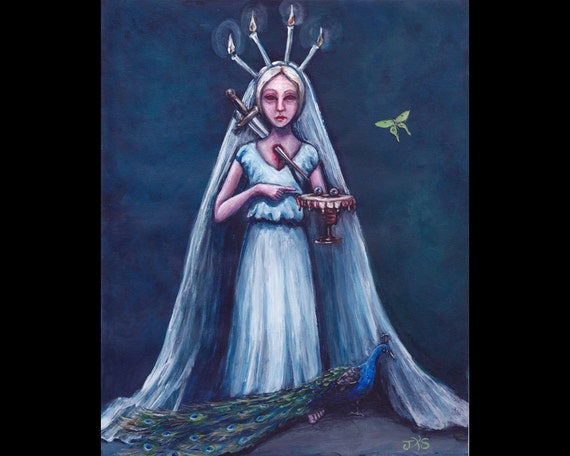
 Saint Lucy or Lucia was a wealthy Christian martyr now venerated as a saint. She continued to speak against her accusers even when they pierced her throat with a dagger. She is the patron saint of the blind. An apocryphal story claims that she tore our her own eyes and gave them to a suitor who said he admired them, so that the rest of her might live unto God. Her name comes from lux, meaning light and her day was commonly described as the shortest day of the year. She is particularly celebrated in Scandinavian countries because of their cold dark winters. Celebrants of her day wear wreaths of candles on their head.
Here is the finished painting

You can read more about it Here at My Good Babushka