Showing posts with label poison. Show all posts
Tuesday, June 28, 2016
P is for Poison
Labels:
ABCs,
alphabet,
art,
death,
embroidery,
execution,
hand embroidery,
needlework,
poison,
tapestry,
work in progress
Monday, May 23, 2016
P is for Poison
P is for Poison. From my Executioner's Alphabet, tapestry in progress. Each panel is hand embroidered, approximately 9" x 12", cotton floss on cotton canvas. They will be sewn together into one big piece at the end.
Labels:
alphabet,
art,
death,
embroidery,
execution,
hand embroidery,
mortality,
needlework,
poison,
skeletons
Tuesday, May 10, 2016
Wednesday, April 27, 2016
O is for Oubliette and P is for Poison
O is for Oubliette. Hand embroidered panel, approximately 9" x 12", just finished.
P is for Poison, just sketched out on canvas and ready to be embroidered.
Both are part of my Executioner's Alphabet Tapestry in progress.
Labels:
alphabet,
art,
death,
embroidery,
execution,
hand embroidery,
macabre art,
needlework,
oubliette,
poison,
skeletons
Wednesday, August 6, 2014
St. John the Evangelist
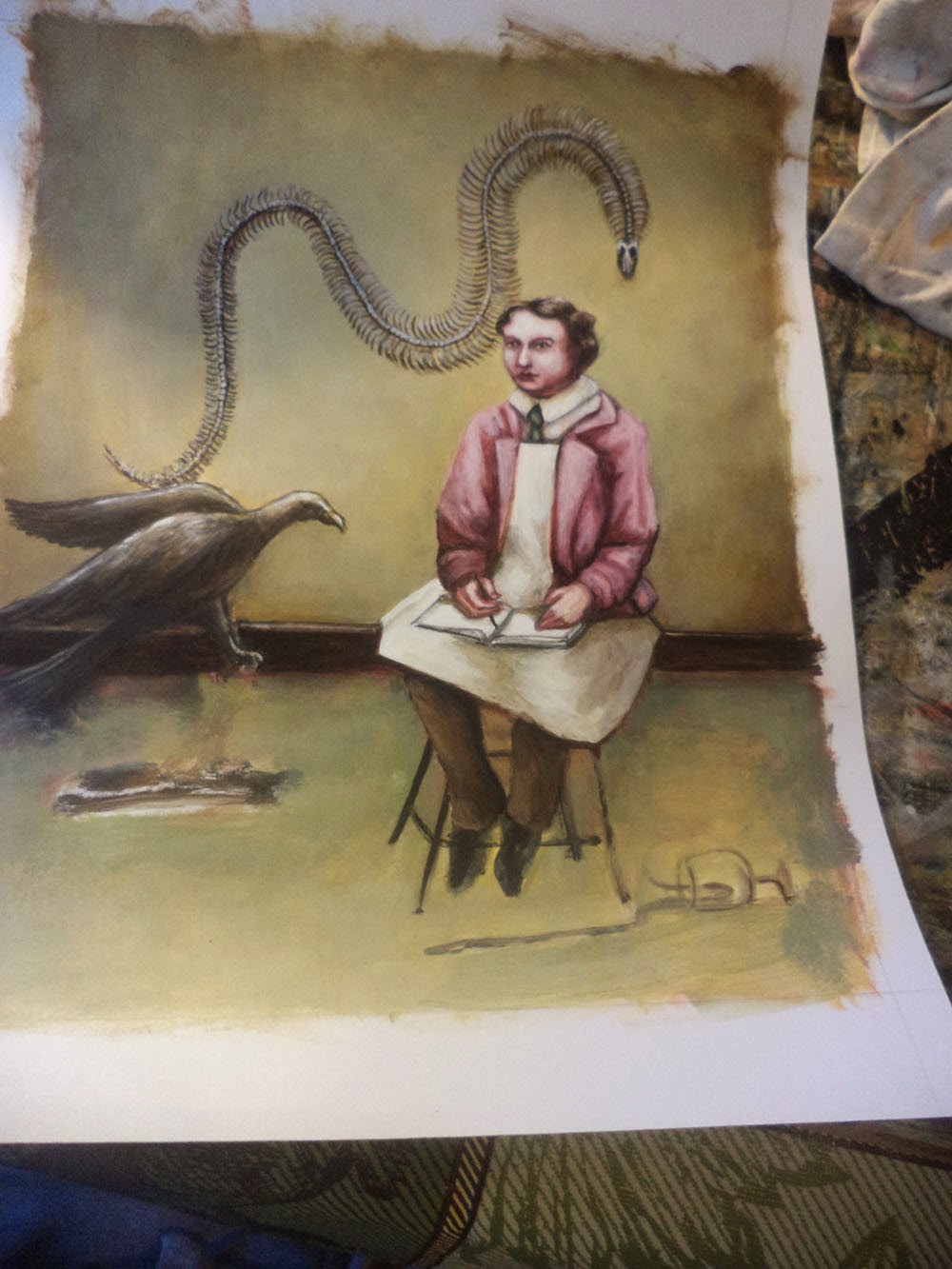
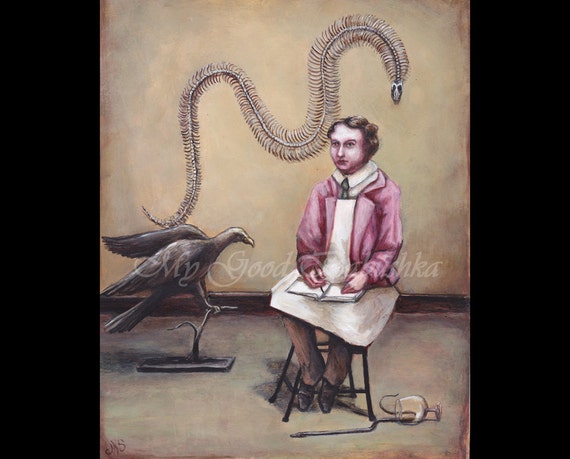
St. John the Evangelist at My Good Babushka. A creative interpretation of St. John the Evangelist. St John is often depicted writing the book of revelations, and with an eagle. He is said to have dumped out a cup of poison which transformed into a snake and slithered away into the wide, wicked world. St. John is sometimes depicted wearing pink and is sometimes confused with Mary Magdalene. I’ve fused the story of St. John the Evangelist and the recent pieces I’ve been doing that have a Victorian/ early natural history museum toner. My St. John is a young scientist taking notes next to his taxidermy eagle. A snake skeleton is mounted on the wall behind him, and at his feet a serpent slithers out of a brandy snifter.
Original acrylic on paper painting, approximately 8" x 10", by Julie Kwiatkowski Schuler. The painting does contain the "My Good Babushka" watermark, or the black side bars, which were included here for security and formatting purposes.
Tuesday, August 5, 2014
St. John the Evangelist
A creative interpretation of St. John the Evangelist. St John is often depicted writing the book of revelations, and with an eagle. He is said to have dumped out a cup of poison which transformed into a snake and slithered away into the wide, wicked world. St. John is sometimes depicted wearing pink and is sometimes confused with Mary Magdalene. I’ve fused the story of St. John the Evangelist and the recent pieces I’ve been doing that have a Victorian/ early natural history museum toner. My St. John is a young scientist taking notes next to his taxidermy eagle. A snake skeleton is mounted on the wall behind him, and at his feet a serpent slithers out of a brandy snifter.
Work in progress today.
Tuesday, October 1, 2013
St. Anastasia, Protectress from Poisons, Patroness of Weavers
Here is the finished painting of St. Anastasia:
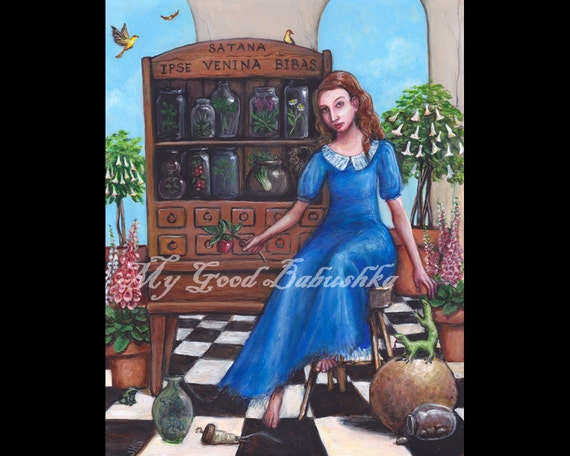
Saint Anastasia was an early Christian martyr known as a deliverer from
poisons, exorcist, and patroness of weavers. This is a painting devoted
to her and full of symbolism. The birds are golden weavers because she
is the patroness of weavers. In the background, flanking the apothecary
cabinet are angel trumpets and foxglove, both very poisonous plants,
because she is a deliverer from poisons.
The top of the apothecary cabinet is inscribed with the Latin "Satana Ipse Venina Bibas" which translates into "Satan, take the poison yourself." because she is a noted exorcist. The apothecary cabinet is filled with nine herbs- mugwort, plantain, betony, chamomile, nettle, crab apple, chervil, and fennel- because those are the nine plants named in the ancient Anglo-Saxon nine herb charm that was supposed to be a powerful antidote against poisons, mainly snake venom. In the corner of the apothecary cabinet is the golden weaver bird's nest.
There is a frog at the base of the left potted foxglove, very often thought in medieval time to be venomous, and inhabiting areas of unhealthful miasmas. The saint's dress in raveling and the thread is tangled up in a witch bottle. A bottle with tangled string is called a witch bottle, it is a labyrinth in brief, and if you put a witch bottle outside your home, it was thought to confuse witches and other evil entities and prevent them from coming into your home. Next to the witch bottle is a drop spindle, another sign of the weaver. On the right side corner of the painting is a jar of bezoars, supposed to have great medicinal value in the middle ages. An amphibaena is brought to heel at her hand, the amphisbaena anciently believed to be a reptile with a head at either end of it's body which can poison by it's eyes.
Amongst all these symbols of ancient to medieval wonder and miracle, Saint Anastasia sits offering the apple, the symbol of knowledge, freedom from superstition and folklore, but also a symbol of the fall from grace and of our mortality.
This is an original painting, approximately 8" x 10". Painted and signed by Julie Kwiatkowski Schuler. The black borders and "My Good Babushka" watermark are not on the actual painting.
The top of the apothecary cabinet is inscribed with the Latin "Satana Ipse Venina Bibas" which translates into "Satan, take the poison yourself." because she is a noted exorcist. The apothecary cabinet is filled with nine herbs- mugwort, plantain, betony, chamomile, nettle, crab apple, chervil, and fennel- because those are the nine plants named in the ancient Anglo-Saxon nine herb charm that was supposed to be a powerful antidote against poisons, mainly snake venom. In the corner of the apothecary cabinet is the golden weaver bird's nest.
There is a frog at the base of the left potted foxglove, very often thought in medieval time to be venomous, and inhabiting areas of unhealthful miasmas. The saint's dress in raveling and the thread is tangled up in a witch bottle. A bottle with tangled string is called a witch bottle, it is a labyrinth in brief, and if you put a witch bottle outside your home, it was thought to confuse witches and other evil entities and prevent them from coming into your home. Next to the witch bottle is a drop spindle, another sign of the weaver. On the right side corner of the painting is a jar of bezoars, supposed to have great medicinal value in the middle ages. An amphibaena is brought to heel at her hand, the amphisbaena anciently believed to be a reptile with a head at either end of it's body which can poison by it's eyes.
Amongst all these symbols of ancient to medieval wonder and miracle, Saint Anastasia sits offering the apple, the symbol of knowledge, freedom from superstition and folklore, but also a symbol of the fall from grace and of our mortality.
This is an original painting, approximately 8" x 10". Painted and signed by Julie Kwiatkowski Schuler. The black borders and "My Good Babushka" watermark are not on the actual painting.
You can find purchasing information here at My Good Babushka
Labels:
apothecary,
art,
Christian martyr,
exorcism,
folklore,
herb,
history,
medicine,
nine herb charm,
painting,
poison,
saint,
satan,
St. Anastasia,
weavers,
witch bottle
Monday, September 30, 2013
St. Anastasia, Patroness of Weavers, Protectress against Poisons
I've finished my herbs on the shelf for my Anglo-Saxon nine herbs charm, an ancient medicine against venom, with the final additions of chervil and fennel. In the right corner of the second shelf is a golden weaver's nest. the hem of her dress is unraveling and the tangled bit of thread is enclosed in a witch bottle. A witch bottle is a labyrinth in miniature and it is said that evil will get lost amongst the convoluted paths of the thread. Witch bottles were hung outside of houses to ward off bad spirits. Next to the witch bottle is a drop spindle, another sign of the weaver. And at the base of the potted foxglove on the left is a frog, which were thought to be venomous and to inhabit areas of unhealthful miasmas, like swamps.
Labels:
art,
charms,
Christian martyr,
faith,
folklore,
herbs,
medicine,
painting,
poison,
spells,
St. Anastasia,
weavers,
witch bottle
Tuesday, September 24, 2013
St. Anastasia Protectress Against Poisons, Patroness of Weavers
In my portrait of St. Anastasia, so far, I have golden weaver birds because she is the patron saint of weavers. She was an exorcist, so her apothecary cabinet says "Satana, Ipse Venina Bibas" translated- "Satan, Take the Poison Yourself". The first two herbs in the jars on the shelf are mugwort and plantain, the first two herbs of the ancient Anglo-Saxon nine herb charm that was an antidote for snake poisoning. Growing in the background are to angel trumpet plants, very toxic, highly poisonous plants that remain under her watchful care.
Labels:
art,
Christian martyr,
exorcist,
folklore,
history,
painting,
poison,
St. Anastasia,
symbolism,
weavers
Friday, September 20, 2013
St. Anastasia Patroness of Weavers and Protectress from Poisons
Because St. Anastasia is a Patroness of Weavers, I've begun my painting with some golden weaver birds. St. Anastasia was also an exorcist, so on her apothecary cabinet is inscribed the Latin phrase "Satana Ipse Venina Bibas" which translates to "Satan, take the poison yourself."
Labels:
apothecary,
art,
Christian martyr,
exorcist,
folk lore,
painting,
poison,
St. Anastasia,
symbolism,
weavers
Thursday, September 19, 2013
Saint Anastasia Protectress Against Poisons and Patroness of Weavers
This is my painting of Saint Anastasia, a Christian saint and martyr who died at Sirmium. She is a healer and an exorcist. Her relics lie at the Cathedral of St. Anastasia in Zadar, Croatia. There will be much to describe in this painting. I hope to explain it bit by bit as I proceed.
Thursday, July 4, 2013
Foxglove
A gardening interlude to show off my foxglove. Also called, fairy caps, digitalis, witch's gloves, dead man's bells and bloody fingers. Spikes of fairy tale perfect little bells. Very poisonous. I read that Van Gogh took digitalis to try to ease a seizure disorder and the visual hallucinatory effect was that the points of light he saw were ringed with halos. So maybe we can thank our little foxgloves for Starry Night.
Subscribe to:
Posts (Atom)