Showing posts with label conjoined twins. Show all posts

Tuesday, October 15, 2013

The Biddenden Maids Embroidery


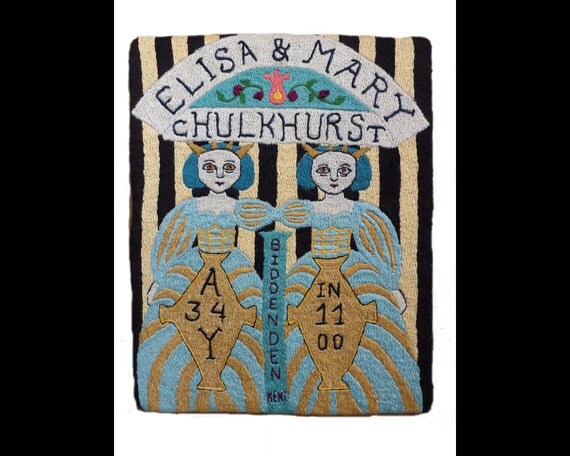
Mary and Elisa Chulkhurst are the Biddenden Maids. Conjoined twins supposedly born in Biddenden, Kent, England, in the year 1100. They are said to have been joined at both the shoulder and the hip, and to have lived for 34 years. It is claimed that on their death they gave five plots of land to the village, known as the Bread and Cheese Lands. The income from these lands was used to pay for an annual dole of food and drink to the poor every Easter. Since at least 1775, the dole has included Biddenden cakes, hard biscuits imprinted with an image of two conjoined women. It is doubtful that the maids existed. There has never been a record of twins joined at the hip and shoulder, and some researchers have suggested that the women printed on the biscuit were meant to be the image of poor widows to whom the charity was given.

This is my embroidered tribute to the extraordinary, imaginary creatures and their lovely story. Hand embroidered with cotton floss on cotton canvas, approximately 8 and 3/4" x 11". Stretched over a paper board mount, matted and framed. One of a kind artwork.
You can find purchasing information on the Biddenden Maids at My Good Babushka.

Friday, September 27, 2013

The Biddenden Maids Embroidery

Mary and Elisa Chulkhurst were known as the Biddenden Maids, conjoined twins born in Biddenden, Kent, England, in the year 1100. They are said to have been joined at both the shoulder and the hip, and to have lived for 34 years. On their death they gave five plots of land to the village, known as the Bread and Cheese Lands. The income from these lands was used to pay for an annual gift of food and drink to the poor every Easter. Since at least 1775, the dole has included Biddenden cakes, biscuits imprinted with an image of two conjoined women.

This is my embroidered tribute to the story of the maids.

Monday, September 23, 2013

The Biddenden Maids Embroidery


Mary and Elisa Chulkhurst commonly known as the Biddenden Maids, were a pair of conjoined twins supposedly born in Biddenden, Kent, England, in the year 1100. They are said to have been joined at both the shoulder and the hip, and to have lived for 34 years. It is claimed that on their death they gave five plots of land to the village, known as the Bread and Cheese Lands. The income from these lands was used to pay for an annual dole of food and drink to the poor every Easter. Since 1775, the dole has included Biddenden cakes, hard biscuits imprinted with an image of two conjoined women. From the surviving mold that was used to print the cakes, I've designed an embroidered tribute to these lovely creatures, who even though they probably never existed, should have, if this were any kind of world at all.

Wednesday, July 17, 2013

Didymus


I have finished Didymus. Here is how the completed work looks:

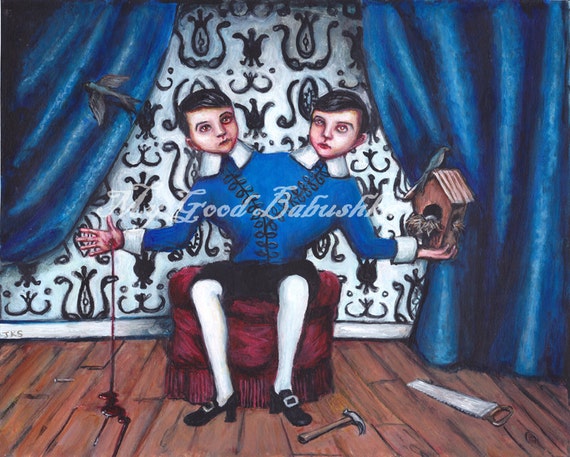
This painting is inspired by my reading of The Golden Legend by Jacobus de Voragine. He wrote a compendium of the saints. This one in particular is for St. Thomas the Apostle. Thomas was called the twin of Jesus, also Didymus, which means twin. I have represented Thomas as conjoined twins. Conjoined twins reinforce the notion of a spiritual connectivity, as feeling and living in the same body must give a unique connectivity that transcends what most people will ever experience. This particular twin configuration was inspired by the Tocci twins, Giacomo and Giovanni. Giacomo and Giovanni Tocci were conjoined twins born in Italy in the late 19th century.

Saint Thomas was an architect. So I've represented that with the building tools and the birdhouse. The holy spirit is usually represented as a dove, so I thought a birdhouse would be a most appropriate construction. The other hand is covered in blood because Thomas was a doubter, and he could only be convinced of the resurrection by putting his hand in the wound of Christ. The closure on the front of the jacket is in the shape of a Y, echoing the Y incision that a doctor would use in an autopsy. It is a wound that signifies inquiry and investigation.

This is an original painting by Julie Kwiatkowski Schuler, acrylic on acid free paper 8" x 10"
The "My Good Babushka" watermark is for security purposes and is not on the painting.

You can find purchasing information Here at My Good Babushka.

Tuesday, July 16, 2013

Didymus


 Sharpening up the details of the right side twin and figuring out how to get the floor on that side sorted out.

If you're new to this painting:
This painting is inspired by my reading of The Golden Legend by Jacobus de Voragine. He wrote a compendium of the saints. This one in particular is for St. Thomas the Apostle. Thomas was called the twin of Jesus, also Didymus, which means twin. I have represented Thomas as conjoined twins. Conjoined twins reinforce the notion of a spiritual connectivity, as feeling and living in the same body must give a unique connectivity that transcends what most people will ever experience. This particular twin configuration was inspired by the Tocci twins, Giacomo and Giovanni. Giacomo and Giovanni Tocci were conjoined twins born in Italy in the late 19th century. Saint Thomas was an architect. So I've represented that with the building tools and the birdhouse. The holy spirit is usually represented as a dove, so I thought a birdhouse would be a most appropriate construction. The other hand is covered in blood because Thomas was a doubter, and he could only be convinced of the resurrection by putting his hand in the wound of Christ. The closure on the front of the jacket is in the shape of a Y, echoing the Y incision that a doctor would use in an autopsy. It is a wound that signifies inquiry and investigation.

Friday, July 12, 2013

Didymus


Worked on the second face, right side curtains, floorboards, straightening up some of that wallpaper pattern today.

This painting is inspired by my reading of The Golden Legend by Jacobus de Voragine. He wrote a compendium of the saints. This one in particular is for St. Thomas the Apostle. Thomas was called the twin of Jesus, also Didymus, which means twin. I have represented Thomas as conjoined twins. Conjoined twins reinforce the notion of a spiritual connectivity, as feeling and living in the same body must give a unique connectivity that transcends what most people will ever experience. This particular twin configuration was inspired by the Tocci twins, Giacomo and Giovanni. Giacomo and Giovanni Tocci were conjoined twins born in Italy in the late 19th century. Saint Thomas was an architect. So I've represented that with the building tools and the birdhouse. The holy spirit is usually represented as a dove, so I thought a birdhouse would be a most appropriate construction. The other hand is covered in blood because Thomas was a doubter, and he could only be convinced of the resurrection by putting his hand in the wound of Christ. The closure on the front of the jacket is in the shape of a Y, echoing the Y incision that a doctor would use in an autopsy. It is a wound that signifies inquiry and investigation.

Thursday, July 11, 2013

Didymus


 Some bits of the wall paper need to be reworked, but I felt like moving on and doing the face. I also need to fix up that hand.

This painting is inspired by my reading of The Golden Legend by Jacobus de Voragine. He wrote a compendium of the saints. This one in particular is for St. Thomas the Apostle. Thomas was called the twin of Jesus, also Didymus, which means twin. I have represented Thomas as conjoined twins. Conjoined twins reinforce the notion of a spiritual connectivity, as feeling and living in the same body must give a unique connectivity that transcends what most people will ever experience. This particular twin configuration was inspired by the Tocci twins, Giacomo and Giovanni. Giacomo and Giovanni Tocci were conjoined twins born in Italy in the late 19th century. Saint Thomas was an architect. So I've represented that with the building tools and the birdhouse. The holy spirit is usually represented as a dove, so I thought a birdhouse would be a most appropriate construction. The other hand is covered in blood because Thomas was a doubter, and he could only be convinced of the resurrection by putting his hand in the wound of Christ. The closure on the front of the jacket is in the shape of a Y, echoing the Y incision that a doctor would use in an autopsy. It is a wound that signifies inquiry and investigation.

Monday, July 8, 2013

Didymus


Damask wallpaper is always a gruesome undertaking. I think in the end it will be worth it.

This painting is inspired by my reading of The Golden Legend by Jacobus de Voragine. He wrote a compendium of the saints. This one in particular is for St. Thomas the Apostle. Thomas was called the twin of Jesus, also Didymus, which means twin. I have represented Thomas as conjoined twins. Conjoined twins reinforce the notion of a spiritual connectivity, as feeling and living in the same body must give a unique connectivity that transcends what most people will ever experience. This particular twin configuration was inspired by the Tocci twins, Giacomo and Giovanni. Giacomo and Giovanni Tocci were conjoined twins born in Italy in the late 19th century. Saint Thomas was an architect. So I've represented that with the building tools and the birdhouse. The holy spirit is usually represented as a dove, so I thought a birdhouse would be a most appropriate construction. The other hand is covered in blood because Thomas was a doubter, and he could only be convinced of the resurrection by putting his hand in the wound of Christ. The closure on the front of the jacket is in the shape of a Y, echoing the Y incision that a doctor would use in an autopsy. It is a wound that signifies inquiry and investigation.

Friday, July 5, 2013

St Thomas the Apostle. Didymus. The Twin. The Doubter. The Architect.


This sketch is inspired by my reading of The Golden Legend by Jacobus de Voragine. He wrote a compendium of the saints. This one in particular is for St. Thomas the Apostle. Thomas was called the twin of Jesus, also Didymus, which means twin. I have represented Thomas as conjoined twins. Conjoined twins reinforce the notion of a spiritual connectivity, as feeling and living in the same body must give a unique connectivity that transcends what most people will ever experience. This particular twin configuration was inspired by the Tocci twins, Giacomo and Giovanni. Giacomo and Giovanni Tocci were conjoined twins born in Italy in the late 19th century. Saint Thomas was an architect. So I've represented that with the building tools and the birdhouse. The holy spirit is usually represented as a dove, so I thought a birdhouse would be a most appropriate construction. The other hand is covered in blood because Thomas was a doubter, and he could only be convinced of the resurrection by putting his hand in the wound of Christ. I think the closure on the front of the jacket is going to be in the shape of a Y, echoing the Y incision that a doctor would use in an autopsy. It is a wound that signifies inquiry and investigation.

Monday, June 24, 2013

Thomas Thomas


This sketch is inspired by my reading of The Golden Legend by Jacobus de Voragine. He wrote a compendium of the saints. This one in particular is for St. Thomas the Apostle. Thomas was called the twin of Jesus, also Didymus, which means twin. I have represented Thomas as conjoined twins. Conjoined twins reinforce the notion of a spiritual connectivity, as feeling and living in the same body must give a unique connectivity that transcends what most people will ever experience. This particular twin configuration was inspired by the Tocci twins, Giacomo and Giovanni. Giacomo and Giovanni Tocci were dicephalic conjoined twins born in Italy in the late 19th century. Saint Thomas was an architect. So I've represented that with the building tools and the birdhouse. The holy spirit is usually represented as a dove, so I thought a birdhouse would be a most appropriate construction. The other hand is covered in blood because Thomas was a doubter, and he could only be convinced of the resurrection by putting his hand in the wound of Christ.


Tuesday, April 20, 2010