Anesthesia. By Julie Kwiatkowski Schuler.
Showing posts with label medicine. Show all posts
Friday, June 3, 2016
Thursday, June 2, 2016
Anesthesia
Labels:
anesthesia,
art,
doctor,
history of medicine,
medicine,
painting,
surgery,
vintage medicine
Tuesday, October 1, 2013
St. Anastasia, Protectress from Poisons, Patroness of Weavers
Here is the finished painting of St. Anastasia:
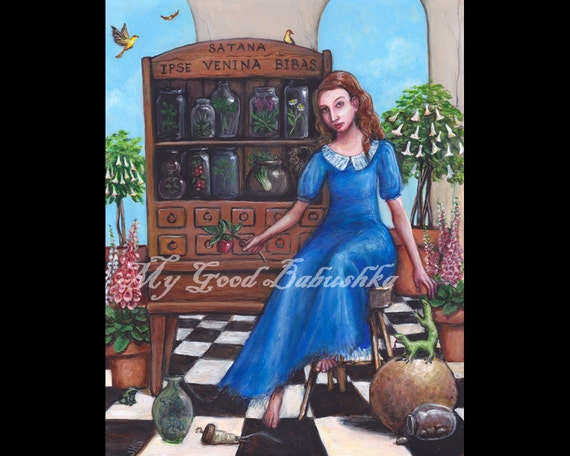
Saint Anastasia was an early Christian martyr known as a deliverer from
poisons, exorcist, and patroness of weavers. This is a painting devoted
to her and full of symbolism. The birds are golden weavers because she
is the patroness of weavers. In the background, flanking the apothecary
cabinet are angel trumpets and foxglove, both very poisonous plants,
because she is a deliverer from poisons.
The top of the apothecary cabinet is inscribed with the Latin "Satana Ipse Venina Bibas" which translates into "Satan, take the poison yourself." because she is a noted exorcist. The apothecary cabinet is filled with nine herbs- mugwort, plantain, betony, chamomile, nettle, crab apple, chervil, and fennel- because those are the nine plants named in the ancient Anglo-Saxon nine herb charm that was supposed to be a powerful antidote against poisons, mainly snake venom. In the corner of the apothecary cabinet is the golden weaver bird's nest.
There is a frog at the base of the left potted foxglove, very often thought in medieval time to be venomous, and inhabiting areas of unhealthful miasmas. The saint's dress in raveling and the thread is tangled up in a witch bottle. A bottle with tangled string is called a witch bottle, it is a labyrinth in brief, and if you put a witch bottle outside your home, it was thought to confuse witches and other evil entities and prevent them from coming into your home. Next to the witch bottle is a drop spindle, another sign of the weaver. On the right side corner of the painting is a jar of bezoars, supposed to have great medicinal value in the middle ages. An amphibaena is brought to heel at her hand, the amphisbaena anciently believed to be a reptile with a head at either end of it's body which can poison by it's eyes.
Amongst all these symbols of ancient to medieval wonder and miracle, Saint Anastasia sits offering the apple, the symbol of knowledge, freedom from superstition and folklore, but also a symbol of the fall from grace and of our mortality.
This is an original painting, approximately 8" x 10". Painted and signed by Julie Kwiatkowski Schuler. The black borders and "My Good Babushka" watermark are not on the actual painting.
The top of the apothecary cabinet is inscribed with the Latin "Satana Ipse Venina Bibas" which translates into "Satan, take the poison yourself." because she is a noted exorcist. The apothecary cabinet is filled with nine herbs- mugwort, plantain, betony, chamomile, nettle, crab apple, chervil, and fennel- because those are the nine plants named in the ancient Anglo-Saxon nine herb charm that was supposed to be a powerful antidote against poisons, mainly snake venom. In the corner of the apothecary cabinet is the golden weaver bird's nest.
There is a frog at the base of the left potted foxglove, very often thought in medieval time to be venomous, and inhabiting areas of unhealthful miasmas. The saint's dress in raveling and the thread is tangled up in a witch bottle. A bottle with tangled string is called a witch bottle, it is a labyrinth in brief, and if you put a witch bottle outside your home, it was thought to confuse witches and other evil entities and prevent them from coming into your home. Next to the witch bottle is a drop spindle, another sign of the weaver. On the right side corner of the painting is a jar of bezoars, supposed to have great medicinal value in the middle ages. An amphibaena is brought to heel at her hand, the amphisbaena anciently believed to be a reptile with a head at either end of it's body which can poison by it's eyes.
Amongst all these symbols of ancient to medieval wonder and miracle, Saint Anastasia sits offering the apple, the symbol of knowledge, freedom from superstition and folklore, but also a symbol of the fall from grace and of our mortality.
This is an original painting, approximately 8" x 10". Painted and signed by Julie Kwiatkowski Schuler. The black borders and "My Good Babushka" watermark are not on the actual painting.
You can find purchasing information here at My Good Babushka
Labels:
apothecary,
art,
Christian martyr,
exorcism,
folklore,
herb,
history,
medicine,
nine herb charm,
painting,
poison,
saint,
satan,
St. Anastasia,
weavers,
witch bottle
Monday, September 30, 2013
St. Anastasia, Patroness of Weavers, Protectress against Poisons
I've finished my herbs on the shelf for my Anglo-Saxon nine herbs charm, an ancient medicine against venom, with the final additions of chervil and fennel. In the right corner of the second shelf is a golden weaver's nest. the hem of her dress is unraveling and the tangled bit of thread is enclosed in a witch bottle. A witch bottle is a labyrinth in miniature and it is said that evil will get lost amongst the convoluted paths of the thread. Witch bottles were hung outside of houses to ward off bad spirits. Next to the witch bottle is a drop spindle, another sign of the weaver. And at the base of the potted foxglove on the left is a frog, which were thought to be venomous and to inhabit areas of unhealthful miasmas, like swamps.
Labels:
art,
charms,
Christian martyr,
faith,
folklore,
herbs,
medicine,
painting,
poison,
spells,
St. Anastasia,
weavers,
witch bottle
Thursday, September 26, 2013
St. Anastasia, Patroness of Weavers, Protectress from Poisons
Continuing to put my nine herbs from the Anglo-Saxon nine herbs charm into the apothecary cabinet, I've added chamomile to the top right, then underneath I've added nettles and crab apple. Flanking the apothecary cabinet are angel trumpets and foxglove, both noted for their poisonous properties. In the air are golden weaver birds because St. Anastasia is the patroness of weaver. She was also a noted exorcist, so her apothecary cabinet says "Satana Ipse Venina Bibas" or "Satan, take the poison yourself."
Wednesday, September 25, 2013
St Anastasia
St. Anastasia was a deliverer from poisons and potions, so in her apothecary cabinet I'm putting the nine herbs from the ancient Anglo-Saxon nine herbs charm that was thought to be an antidote for poison, especially venomous bits. So far I've gotten mugwort, plantain, watercress, and betony into their jars.
Labels:
art,
charms,
Christian martyr,
folklore,
herbs,
medicine,
nine herbs charm,
painting,
St. Anastasia,
symbolism
Tuesday, April 30, 2013
Fever Sick
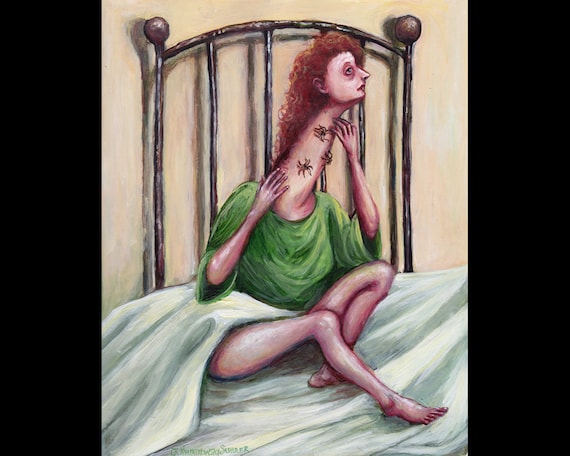
Fever Sick is a painting inspired by my readings of pre-enlightenment faiths and folklore. It was commonly believed that an amulet of three spiders worn about the neck would cure the ague. Although the text didn't specify, I imagine that those spiders would have been dead and perhaps tied in a little sack. I took some artistic license and imagined how it would be to wear three live spiders. I lengthened the neck to Alice in Wonderland proportions so we can get a good feel for the little creatures and how they must feel crawling over our neck. The painting is filled with lots of undertones of sickly greens and yellows. All these elements combined give the picture a very feverish, swooning, and hallucinatory sort of feeling. 8" x 10" acrylic painting on acid free paper by Julie Kwiatkowski-Schuler.
You can get a closer look at this painting Here at My Good Babushka.
Friday, April 26, 2013
Ague
There was a pre-enlightenment tradition of wearing three spiders around one's neck to cure one's self of the ague. I am making a painted illustration of this custom.
Here I've been working on the foldy sheets. Something that's hard to stop once you get started. I'm pretty happy with the sheets under my patient, but the ones draped over the leg need work. I like knobby leg. It's got a lot of good reds and greens in it.
Did a little work on the face. Making it dark around the eye. Sticky hair clinging to the neck. No one likes that.
Here I've been working on the foldy sheets. Something that's hard to stop once you get started. I'm pretty happy with the sheets under my patient, but the ones draped over the leg need work. I like knobby leg. It's got a lot of good reds and greens in it.
Did a little work on the face. Making it dark around the eye. Sticky hair clinging to the neck. No one likes that.
Wednesday, April 24, 2013
Ague
Continuing with my ague painting today. If you want to know what's going on in this painting, you can see yesterday's post.
Making a big column of a neck. I think it will be a good place to show off the spiders. It has an Alice in Wonderland sort of surreal feel. Also invoking the surreal feeling of a fever delirium.
Wednesday, August 15, 2012
Anatomists Embroidery
Returning to a theme I like, I decided to embroider a little scene of three anatomists at work. Approximately 9" x 12" canvas embroidered with cotton floss.
Labels:
anatomist,
anatomy,
cadaver,
dissections,
embroidery,
medicine,
needlework,
sewing,
surgeon,
vintage
Thursday, May 26, 2011
Anatomy School


Since I love them so much, I decided to make another painting from a vintage medical school photo. Here come the little doctors, huzzah for anatomy academy!
Monday, April 25, 2011
The Three Anatomists


Proceeding in a somber palette. This painting is loosely based on a very blurry vintage photo of some medical students dissecting a corpse. I have taken the composition and am filling the faces in with inventions. Though I am inventing the portraits, I have paid a lot of attention to the faces of young anatomists and compared several photos. There is sometimes a look of fear, disgust, coldness, haughtiness.... a lot of visages you would associate with a postures of antagonism.
Labels:
anatomists,
dissection,
medicine,
painting,
vintage
Monday, March 7, 2011
The Three Anatomists


I'm starting a new painting. This is on large, gessoed paper, I think it's 18" x 24". I'm using an old photo for a source image, but liberally improvising. I like putting in the background, layering up a lot of grimy, ochery, umbery paint. I like letting the accidents happen where they will happen. It is a way to approximate the spirit of old photography without being slavish about reproducing it.
Tuesday, September 16, 2008
Anatomical Venus


Here is my representation of the famous Anatomical Venus of Clemente Susini made in the late 18th century. It is interesting to know that wax models of gravid anatomies were produced until the 1940s because pregnant cadavers are in somewhat short supply.
I will be using this painting, perhaps to make postcards for Zombie Fest. I have also included it in a very special artwork/jewelry box that I am offering on my etsy site.
My Good Babushka!
Subscribe to:
Posts (Atom)